
Sponsored Content
Machinery
Laser engraving/cutting stamps for debossing
12 February 2020
Sponsored content
Laser systems are incredibly versatile tools — not only can beautiful designs or meaningful messages be engraved on popular gift items, but makers can also use them to cut incredibly intricate patterns from a variety of materials.
Another cool thing about having a laser is that makers can create tools and templates that enable users to personalize products in different ways.
Rubber stamps have always been a popular product to create with the laser, but what about other types of stamps?
This video demonstrates how to use a laser to engrave acrylic and wooden stamps to create a debossed design into leather patches.
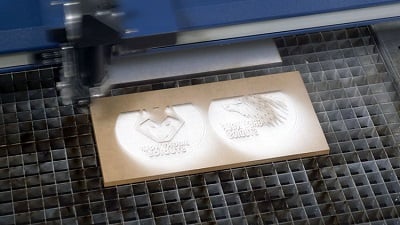 Figure 1: Epilog’s 120-watt Fusion Pro 48. Source: Epilog LaserMakers in the video begin with a handful of pre-cut leather patches and previously prepared artwork. To mimic the artwork, a stamp is pressed into material and the impression on that material will be a reverse image of the stamp. In order for the stamp to read correctly, the graphics on the stamp need to be mirrored.
To do this, Epilog’s 120-watt Fusion Pro 48 was used. The machine comes with a built-in IRIS™ camera system, which makes it very easy to simply click-and-drag and copy-and-paste artwork onto material. This is a very convenient feature of the Fusion Pro, but this project could also be achieved with any of Epilog’s other machines.
To ensure that the raised graphics of the stamps are deep, multiple passes will be required. The resulting depth depends upon the wattage of the laser and the type of material being used for the stamps. For the 120-watt system, two passes did the job nicely. For lower wattage lasers, a third pass may be necessary.
Makers then soak the leather patches. Although this may not be necessary for every material, makers found that soaking these patches in water prior to debossing made them much more pliable and more receptive to the stamping process. The patches were soaked for about one minute each.
In order to achieve a nice, deep impression, the stamp needs to be firmly pressed into the leather. To accomplish this, several clamps were used, but a vice would have also worked well. Makers then used wood blocks to protect the materials from the clamps and to evenly disperse the pressure.
Once completed, the makers created distinctive debossed patches that can be used again and again!
Powered by CR4, the Engineering Community
Discussion – 0 comments
By posting a comment you confirm that you have read and accept our Posting Rules and Terms of Use.
Advertisement
Advertisement
Popular News
Find Free Electronics Datasheets

Advertisement