
Researchers from the Toyohashi University of Technology, The University of Tokyo and Tokyo Metropolitan University have created a virtual walking system that enables stationary users to feel as if they are walking. The new system records one person walking and replays the experience for the user through augmented reality (AR), oscillating flow and synchronous foot vibrations.
Walking uses many senses, including vision, touch, hearing, proprioception, motor commands and action. Because of this, virtually recreating a walking sensation is difficult.
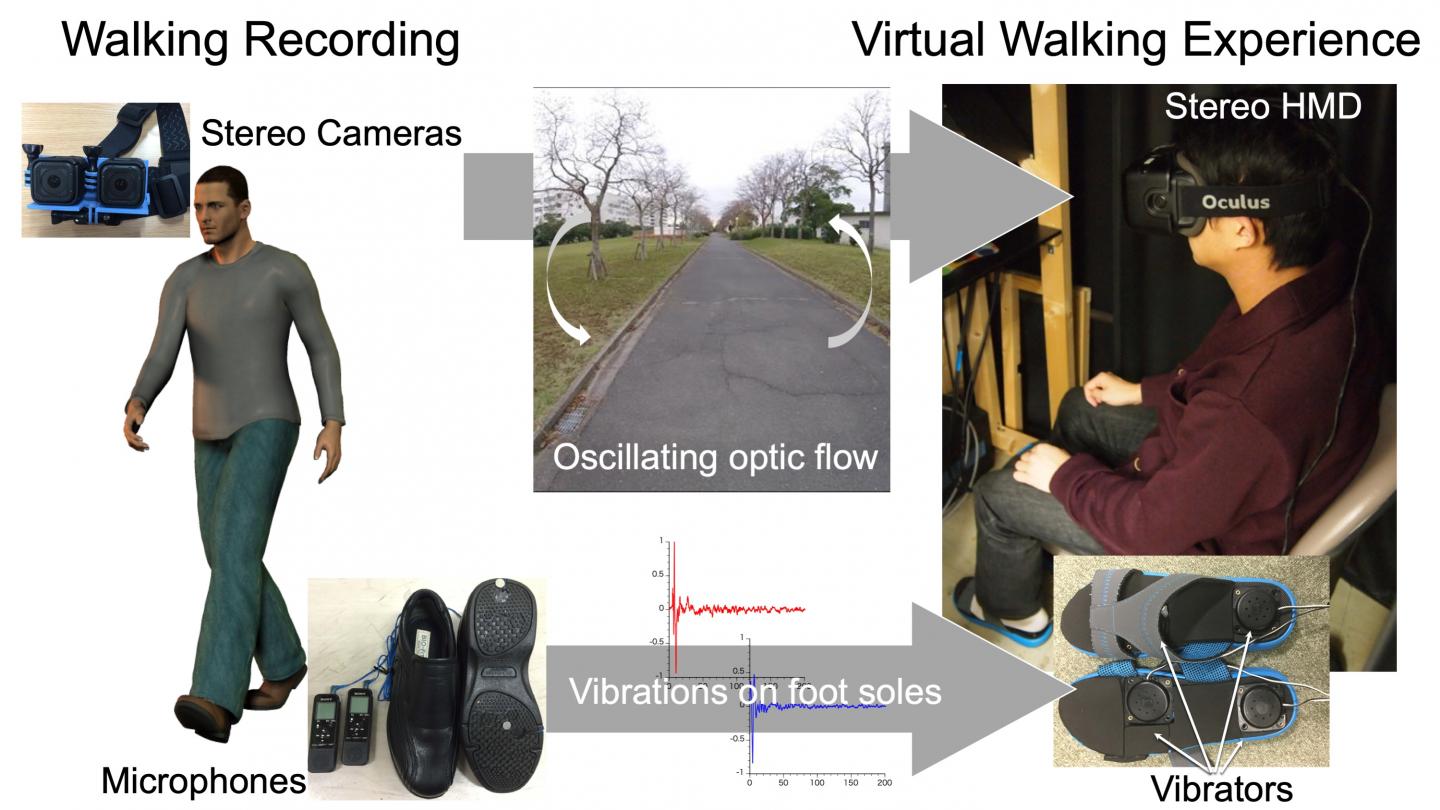 System overview. Source: Toyohashi University of Technology
To create the walking sensation, an AR headset displays the view of the person walking while the oscillating flow and synchronous foot vibrations give the users the sensations of self-motion, walking, leg action and telepresence when they are not actually walking.
A pair of stereo cameras captures the walker’s oscillating optic flow while four microphones embedded in the walker's shoes record the timing of his or her steps. A camera captures the first-person view of the area he or she is walking through. To use the display system, the user wears a head-mounted display (HMD) and four vibrators attached to the heels and feet. The image oscillations and foot vibrations displayed to the user at the same time create a more realistic walking sensation.
Study participants underwent psychological testing to see if the brain had been tricked into thinking it was walking. This testing found that the image oscillations and foot vibrations successfully tricked the brain, and users felt as if they were walking when they were stationary.
The research team wants to further develop the system to enable people to walk on unattainable places, like the moon or ocean floor. Their system could also significantly improve the quality of life for people with walking disabilities.
A paper published on the new system was published in I-Perception.
