
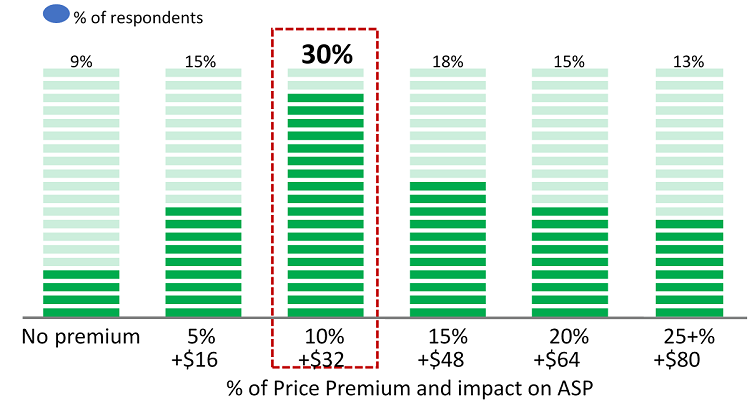
The first 5G smartphones are already on the market and while most early adopters probably expected to pay a bit more for the phones, a price premium as much as 29 times higher than other phones may be more than what consumers bargained for, according to a new survey from IHS Markit.
Of those surveyed, 91% of consumers said they expect to pay more for 5G devices compared to 4G LTE smartphones, but only three-quarters expected to pay a 10% to 25% price premium. However, the Samsung S10 5G, the phone being shipped everywhere worldwide, is retail priced at $1,300, a 335% premium compared to the $388 average selling price for existing 4G smartphone models — a $912 increase in price.
Another example is the recently released Huawei Mate 20 X 5G smartphone that retails for $1,200, which is more than a 400% price premium compared to $285 for Huawei’s 4G models.
IHS Markit believes this type of sticker shock won’t deter early adopters from buying a 5G phone, but it could slow sales elsewhere in the mainstream consumer market.
“The 5G market is primed for massive growth, with the transition to the new technology expected to occur at a much faster pace than any previous wireless generation during the first five years of deployment,” said Joshua Builta, senior principal analyst at IHS Markit. “However, as with each new wireless generation, the first wave of phones carries sky-high costs because of the additional electronics required to support the enhanced features. With smartphone brands passing these additional costs down to consumers, many buyers will be turned off by the high prices and will wait until they come down before purchasing a 5G phone.”
5G handset shipments are forecast to grow to 424.5 million units in 2023, from just under 9.5 million in 2019 and 73.7 million units in 2020.
Why it costs more
Part of the reason for the high cost of the 5G smartphones is that the phones include a complex radio-frequency (RF) subsystem designed to support millimeter wave capability, which is the fastest of the 5G spectrum, the market research firm said.
In some phones such as the Moto Z3 with 5G and Galaxy S10 5G, both integrate multiple separate millimeter wave antenna modules.
IHS Markit forecasts 5G smartphone pricing to decline quickly, probably next year as more smartphones come online and more efficient designs are rolled out.
As more consumers adopt 5G smartphones, they have expectations about what the technology will bring that 4G cannot. This includes faster data speeds, more services including virtual reality, low latency for streaming and wide coverage across cities. Until this happens, telecoms and brands can work to bring the price down in order to increase adoption.
