
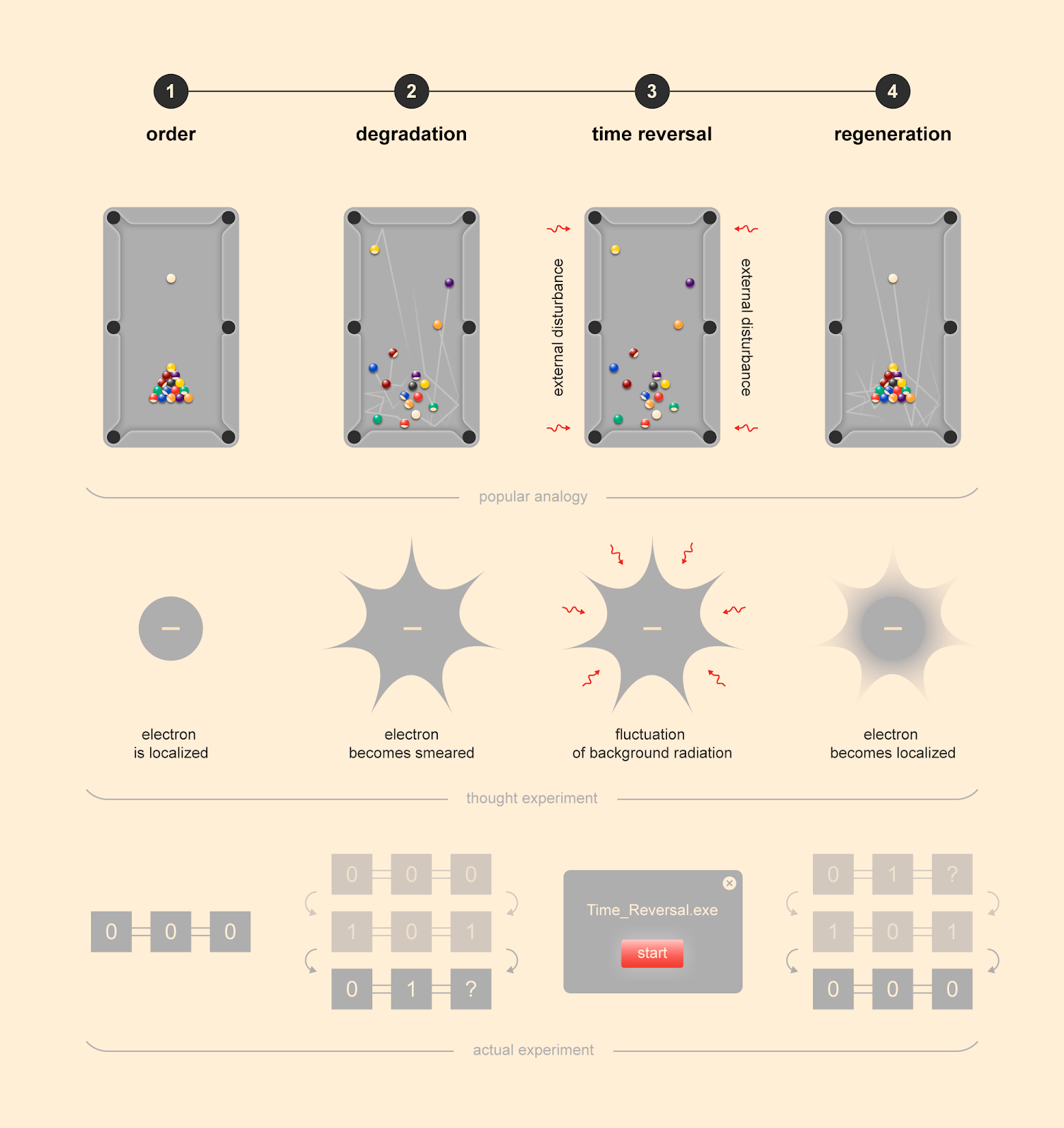
 The four stages of the actual experiment on a quantum computer mirror the stages of the thought experiment involving an electron in space and the imaginary analogy with billiard balls. Each of the three systems initially evolves from order toward chaos, but then a perfectly timed external disturbance reverses this process. Source: @tsarcyanide/MIPT Press Office
The second law of thermodynamics states that the total entropy of an isolated system cannot decrease over time; the arrow of time can only move toward greater entropy. For example, although it is easy to observe a glass shattering, it is unlikely that the shattered glass would be observed returning to its initial unshattered state. Or is it?
A research team from the Moscow Institute of Physics and Technology (MIPT), along with physicists from ETH Zurich and the Argonne National Laboratory (ANL) in the U.S., has been studying this question. In the latest of a series of papers on the topic, the researchers demonstrated the possibility that time can spontaneously reverse itself. They did so by artificially creating “a state that evolves in a direction opposite to that of the thermodynamic arrow of time,” said Gordey Lesovik, head of MIPT’s Laboratory of the Physics of Quantum Information Technology.
The physicists considered a single localized electron, whose position within an area of space they could determine with some certainty. The laws of physics dictate that the region of space containing the electron spreads out quickly and, therefore, the uncertainty of the electron’s position increases.
Schrödinger's equation, which governs the evolution of the electron state, is reversible, explained Valerii Vinokur from Argonne, a co-author of the paper. "Mathematically, it means that under a certain transformation called complex conjugation, the equation will describe a 'smeared' electron localizing back into a small region of space over the same time period." This phenomenon could occur theoretically, “due to a random fluctuation in the cosmic microwave background permeating the universe,” according to the MIPT article.
The team calculated the probability of observing a "smeared out" electron over a fraction of a second spontaneously localizing into its recent past. They found that, “across the entire lifetime of the universe — 13.7 billion years — observing 10 billion freshly localized electrons every second, the reverse evolution of the particle's state would only happen once," according to the article. "And even then, the electron would travel no more than a mere one ten-billionth of a second into the past.”
The researchers next developed a four-stage experiment to reverse time, observing a quantum computer made of superconducting qubits, instead of an isolated electron.
Stage 1, order, corresponded to the localization of the electron observed in the first scenario. Stage 2, degradation, was achieved with the introduction of a controlled program of autonomous evolution (a complex changing pattern of zeros and ones). Stage 3, time reversal, simulated something similar to the random microwave background fluctuation in the electron example. Stage 4, regeneration, used a re-launch of the evolution program to return the qubits to their state in the past.
When the researchers conducted the experiment with a two-qubit computer, 85% of the cases returned to the past state. The introduction of a third qubit increased the number of errors and only 50% of the cases were successful.
The time-reversal algorithm could be used to improve the precision of quantum computers by reducing noise and errors.
(Read: How a quantum computer works)
The study was recently published in Scientific Reports.
