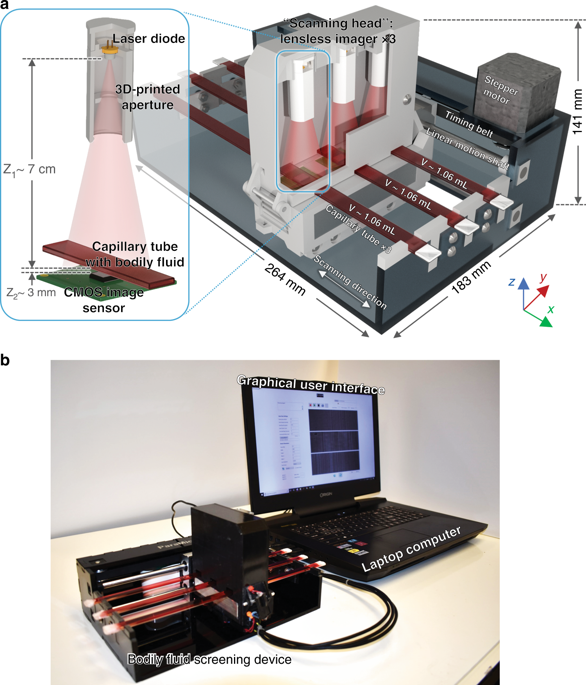
 (a) Schematic of the device based on lensless holographic time-resolved speckle imaging. b) The device is controlled by a laptop, which is also used for processing the acquired data. Source: Ozcan Lab/UCLA
A rapid, inexpensive method has been engineered at the University of California-Los Angeles (UCLA) to detect parasitic infections in resource-poor areas. The mobile platform harnesses lensless imaging to rapidly screen for motile parasites in bodily fluids and can image and analyze 3 mL of a sample within 20 minutes, providing a throughput that is orders of magnitude faster than traditional optical microscopy-based examination.
The latter captures a still image of the sample and searches for parasites in a process that can be problematic if the concentration of parasites in the sample is too low. The new approach seeks motion and records high-frame-rate videos of holographic patterns of the sample illuminated with laser light. A motion analysis algorithm is then applied to analyze the captured videos at the microscale and the locomotion of the target parasites within the sample is converted into a signal spot, which is detected and counted using artificial intelligence technology.
The system was applied to the identification of Trypanosoma, a blood-borne parasite responsible for sleeping sickness and Chagas disease, and Trichomonas vaginalis, which causes trichomoniasis, a sexually transmitted disease. The detection limit was quantified as 10 parasites per milliliter of whole blood, which translates into a fivefold improvement relative to state-of-the-art parasitological detection methods. The enhanced detection limit could improve detection of sleeping sickness and Chagas disease at an earlier stage, which is essential to improve the cure rate and reduce its prevalence.
Research describing the 1.69 kg device is published in Light: Science & Applications.
