
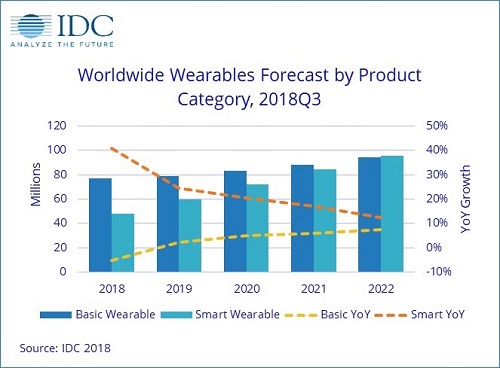
 A new report says that in the next three years, the wearables market will be driven by greater adoption of smartwatches as well as the move to devices that do more than just connect to a smartphone.
The International Data Corp. (IDC) report said global shipments of wearables is expected to jump to 189.9 million units by 2022 up from 125.3 million units in 2018. During this time frame, wearables will manage a compound annual growth rate (CAGR) of 11%.
"The transition from basic wearables to smart wearables will continue over the next five years as the two approach parity in terms of market share by 2022," said Jitesh Ubrani, senior research analyst for IDC's Mobile Device Trackers. "The rise of smart wearables will not just be in mature markets, but also from emerging markets in Asia/Pacific and elsewhere. Japan will play an equally important role as they consume more than one-third of all smart wearables."
Apple will continue to dominate the wearables segment but will decline in overall market share as other platforms gain traction, IDC said. Apple’s market share will decline from 44.4% in 2018 to 35.8% in 2022, according to the report. Android is forecast to be the second largest OS with 22.4% market share in 2022. WearOS, the open source platform that allows developers to create differentiation among wearables, will rank third in 2022 with 19.8% market share. The remainder of the smart wearables landscape will be comprised of vendors such as Samsung, Fitbit and Garmin.
IDC expects smartwatches to evolve in the coming years as manufacturers begin to focus on new means of communication between users and other connected devices. Suppliers will focus on convenience by proactively providing glanceable and actionable information to the user and a renewed focus on health, with smartwatches playing a critical role in tracking health goals and detecting potential ailments.
Wristband wearables will likely grow and serve as a stepping stone to other larger wearables or for use in patient monitoring in the healthcare market. Earwear will also expand during the period, and manufacturers will likely begin producing wireless headphones that include biometric tracking and data.
Learn more about IDC’s wearable findings with its latest tracker.
