
Researchers employed artificial intelligence (AI) to analyze the movements and technology of hunter-gatherer groups of humans who lived in the Southern Cone of South America from around 12,000 B.C. to the end of the 19th century.
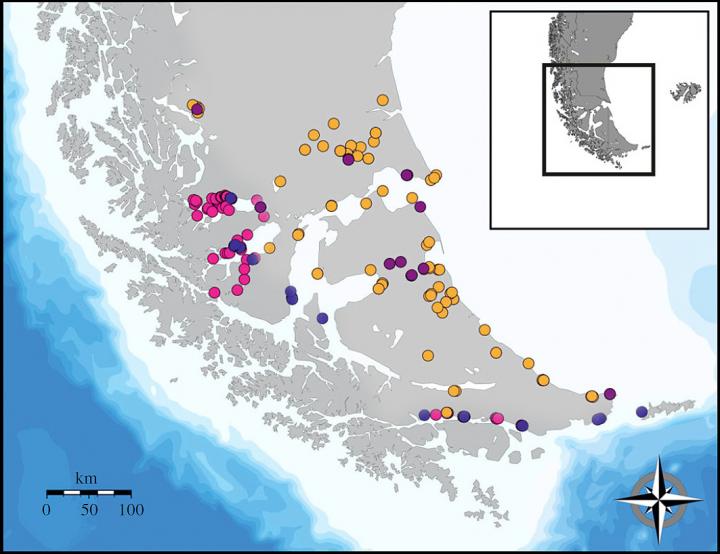 Technological landscapes of nautical mobility (red circles, with some blues that are less well classified by the algorithm) and pedestrian mobility (orange and purple circles) in hunter-gatherer groups that lived in the extreme south of South America. (Source: Briz et al. 2018/Royal Society Open Science)
Humans have lived in South America for at least 14,500 years. Anthropologists have dated human activity in areas like Mount Verde, Chile, back to the early Holocene era. There is evidence that the first settlers of this area traveled even further south.
The team used data from archeological sites in south Patagonia and an AI-based system to study the relationship between group mobility and available technology. The machine learning techniques classified the groups and made predictions as to where the group moved next based on technology and past movements.
"It is by means of automatic classification algorithms that we have identified two technological packages or 'landscapes': one that characterizes pedestrian hunter-gatherer groups (with their own stone and bone tools) and the other characterizing those that had nautical technology, such as canoes, harpoons and mollusk shells used to make beads," explained Ivan Briz i Godino, an archaeologist of the National Council for Scientific and Technical Research (CONICET) of Argentina and co-author of the work.
"In future excavations, when sets of technological elements such as those we have detected appear, we'll be able to directly deduce the type of mobility of the group or the connections with other communities," said Briz.
The findings from the study helped create maps of two ancient human communities. It also enabled the researchers to find large areas where humans interacted and shared knowledge with each other. In the future, the team hopes to expand this study to other countries, eras and groups of ancient people.
"Traditional archaeology identifies sites, societies and their possible contacts on the basis of specific elements selected by specialists (such as designs of weapon tips or decorative elements), but here we show that it is more interesting to analyze sets of technological elements as a whole, using artificial intelligence techniques that allow us to work with large data volumes and without subjective prejudices," concluded Briz.
The paper on this study was published in Royal Society Open Science.
