
Technology for embedding data capture and wireless physical analytics capabilities in 3D-printed medical assistive devices and industrial sensors is being advanced at the University of Washington. The 3D-printed plastic devices need no batteries or electronics to track and store their use. Information is shared by reflecting signals that have been transmitted to it with an antenna.
The researchers previously demonstrated a system that tracks movement in one direction, which is applicable for monitoring liquid levels in a container or measuring wind or water speed. The next goal was to develop objects that could monitor bidirectional motion such as the opening and closing of a pill bottle, effected by the use of two antennas that can be contacted to a switch attached to a gear. The gear moves in one direction as the bottle cap is opened, pushing the switch to contact one of the antennas. The gear turns in the opposite direction as the cap is closed, causing the switch to contact the other antenna. A specific sequencing in the gear teeth encodes a message denoting the direction of movement.
This tracking method was extended to monitor patient use of the 3D-printed e-NABLE arm, which is designed to help children with hand abnormalities grasp objects. When children flex their wrists, cables on the hand tighten to make the fingers close. The prosthetic was printed with a prototype bidirectional sensor that monitors the hand opening and closing by determining the angle of the wrist.
To demonstrate a 3D-printed object that could store its usage information while out of Wi-Fi range, the researchers fabricated an insulin pen that monitors its use and then signals when it was getting low. The prototype enables data capture and storage for later retrieval when outside the range of the wireless coverage, using a ratchet and gear system.
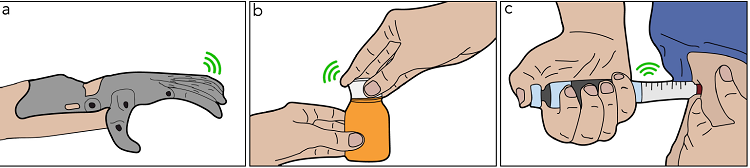 Example applications of backscatter communication technology. (a) Prosthetic arm functioning as a wireless controller. (b) Pill bottle tracks when it is opened and closed. (c) Insulin pen stores usage data when it is outside the range of a wireless receiver. Source: University of Washington
