
Development of the Cryogenic Sapphire Oscillator, also known as the Sapphire Clock, has earned a University of Adelaide team of researchers one of Australia's prestigious Eureka Prizes: the Defence Science and Technology Prize for Outstanding Science in Safeguarding Australia.
The Cryogenic Sapphire Oscillator has a 5 cm cylinder-shaped sapphire crystal that is cooled to about -267°C, 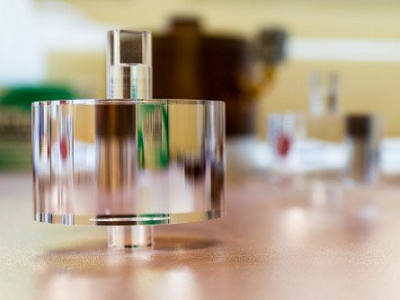 The sapphire crystal at the heart of the clock. Source: University of Adelaide Institute for Photonics and Advanced Sensingor about 5 or 6 degrees above absolute zero. At this temperature, the microwave energy lost in the sapphire crystal is the lowest of any substance on Earth. Microwave radiation is injected into the sapphire crystal and propagates around the circumference of the crystal, just inside the surface. The device produces an extremely pure signal at a microwave frequency of about 10 GHz and allows time measurements with accuracy on the femtosecond scale.
The accuracy of the clock is unparalleled, as it is 1,000 times more precise than any other commercial system. The Sapphire Clock gains or loses only one second over 40 million years while producing an incredibly pure ultra-low noise signal that improves the accuracy of frequency and timing in electronic devices.
According to engineers at the university’s Institute for Photonics and Advanced Sensing and start-up Cryoclock Pty Ltd, the Sapphire Clock can benefit the Jindalee Over-The-Horizon Radar Network (JORN) system, which monitors aircraft and ships off Australia’s northern coast. Its incorporation would enable JORN to generate signals that are 1,000 times purer than its current technology and allow detection of smaller objects at greater distances.
