
Electrospun sodium titanate has been found to speed up the purification of water. Researchers from the University of Helsinki have developed a method based on selective ion exchange which also uses electrospun sodium titanate to remove radioactive strontium.
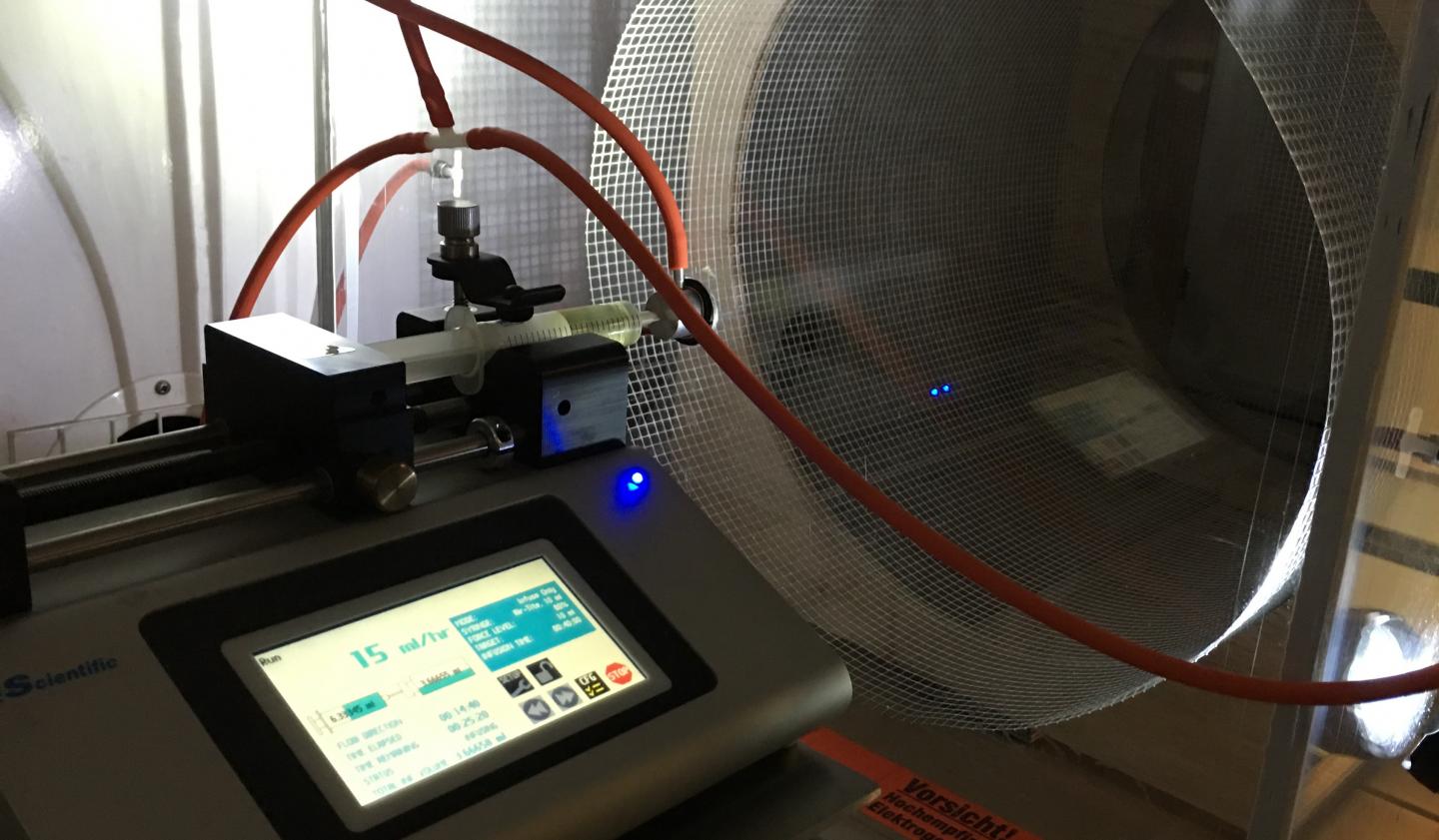 The jet erupting from the end of the needle elongates into a fiber, and the ethanol and acetic acid used as solvents will evaporate. Source: Riitta-Leena Inki
This wastewater treatment method allows the water to be treated faster and leaves less solid radioactive waste than all the previous methods.
“The advantages of electrospun materials are due to the kinetics, i.e. reaction speed, of ion exchange,” says Risto Koivula, a scientist in the research group Ion Exchange for Nuclear Waste Treatment and for Recycling at the Department of Chemistry at the University of Helsinki.
Synthetic sodium titanate is effective at removing strontium. The granular form of sodium titanate is often used in industrial factories to purify large quantities of water, like the wastewater from the Fukushima nuclear disaster in 2011.
The new purification method is based on ion exchanges. When radioactive strontium is run through an ion exchanger, it changes into sodium.
The filtering material of the purification machines needs to be switched out when the ion exchange capacity is reached. When it is switched out, some solid radioactive waste can be left behind. The new system fixes this problem.
“Since less electrospun material is needed from the start of the process, the radioactive waste requiring a permanent repository will also fit in a smaller space,” says Koivula.
The new electrospinning equipment was developed built and tested at the University of Helsinki.
The paper on the new system was published in Environmental Technology.
