
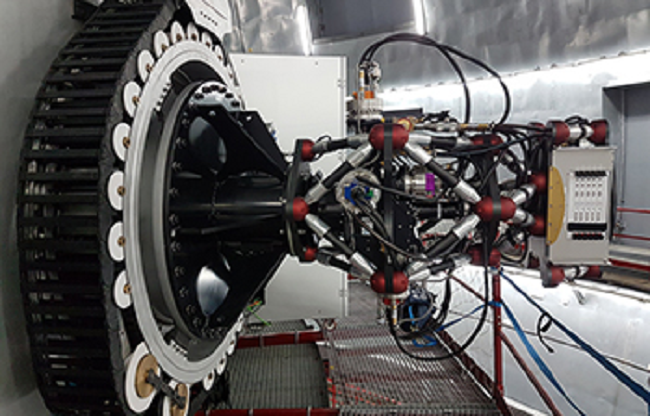
 Close-up view of HiPERCAM mounted on the GTC. Source: University of SheffieldA new camera that can take over 1,000 images per second has been fitted to the world’s largest optical telescope — the Gran Telescopio Canarias (GTC) with a 10.4 meter mirror diameter. HiPERCAM will take high-speed moving images of objects in the universe in five different colors simultaneously, allowing eclipses, explosions and the remnants of dead stars — white dwarfs, neutron stars and black holes — to be studied in unprecedented detail.
The researchers explain that cameras conventionally installed on large telescopes usually capture only one picture every few minutes. HiPERCAM can take one picture every millisecond and provide a slow-motion view of rapidly varying celestial objects. Capturing high-speed images in five colors also enables astronomers to differentiate between hot stars, which burn at tens of thousands degrees Celsius and are blue, and cooler stars that burn at only a few thousand degrees and appear red.
The GTC is based on the island of La Palma, situated 2,500 meters above sea level, which is one of the best places in the world to study the night sky.
HiPERCAM was developed by researchers from the University of Sheffield, the UK Astronomy Technology Centre, Instituto de Astrofisica de Canarias, University of Warwick and Durham University.
