A tool to simplify inspection of engine parts, turbines, reactor pipe elbows and railroad tracks is under development at the University of California-San Diego. These odd-shaped structures are difficult to examine using conventional ultrasound techniques, but a new stretchable, flexible ultrasound patch can eliminate some inspection challenges.
Rigid, flat probes aren’t ideal for imaging internal imperfections inside high stress areas, such as elbows or 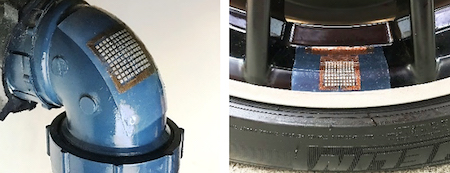 Flexible ultrasound patch can conform to pipe elbows (left), wheel edges (right) and other odd-shaped structures. Source: University of California-San Diegocorners. The new device is designed for the imaging and analysis of such nonplanar, hard-to-access surfaces.
The soft, thin ultrasound patch performs without the use of water, gel or oil commonly used in other methods. The silicone elastomer device is patterned with an island-bridge structure — an array of small electronic parts (islands) each connected by spring-like structures (bridges). The islands contain electrodes and piezoelectric transducers, which produce ultrasound waves when electricity passes through them. The bridges are spring-shaped copper wires that stretch and bend, allowing the patch to conform to nonplanar surfaces without compromising its electronic performance.
The probe was tested on an aluminum block with a wavy surface and defects 2-6 cm below the surface. The researchers collected data by placing the device at different surface sites and used a customized data processing algorithm to reconstruct the images. The stretchable probe effectively images 2-mm-wide holes and cracks inside the sample.
The researchers plan to integrate both power and a data processing function into the soft ultrasound probe, currently in the proof-of-concept stage, to enable wireless, real-time imaging and videoing.
The research is published in Science Advances.