
There’s a sizable industry that’s been built up around monitoring and managing a building’s energy efficiency: consultations, energy audits and in-depth “retro-commissionings,” all of which are designed to point out ways that building owners can reduce their carbon footprints -- and their monthly bills -- through technological fixes.
Many options already exist for monitoring complex variables on a room-by-room basis. But few are accessible to homeowners and building managers who may lack the expertise to set up a wireless sensor network, or the means to pay someone else to do it for them.
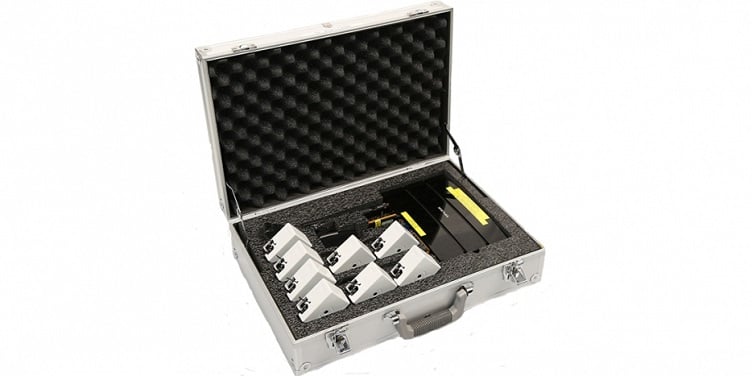
Enter a new device from UC Berkeley and the inter-university ecosystem of CITRIS: the Building-in-Briefcase (BiB) system. The idea, as electrical and computer sciences (EECS) grad student Ming Jin explained, is that “everything is in the briefcase.” That includes a plug-in router and eight battery-powered sensors capable of measuring temperature, humidity, ambient visible light and motion. Some of the sensors also can measure carbon dioxide levels, which can be used to extrapolate the number of room occupancy. The system communicates via Wi-Fi, with data and analytics feeding into a centralized database.
Each of the sensors covers between 25 and 100 square meters depending on room makeup; a full briefcase can cover an office of about 30 people.
“Now someone with little technical knowledge can bring in these wireless briefcase sensors and set up a wireless sensor network and do a survey quickly without all of that engineering expertise,” said Kevin Weekly, Ph.D. EECS, the primary developer of the platform.
One caveat, however, is that the sensors do not transmit to the central database in real time. The Wi-Fi module in each switches on for a few seconds at regular intervals, typically between one and 10 minutes, during which a built-in microcontroller dumps its memory. The upside to this latency is that it makes possible a long battery life – up to nine years with one-minute sampling and 10-minute reporting intervals.
The product is not currently commercialized, but Jin says that this may happen in the future. Approximately 60 briefcases are currently deployed in government, commercial and school buildings across Singapore, where heat, humidity and air-conditioning demands are bigger issues than they are in Berkeley. The BiB project was funded by the Republic of Singapore’s National Research Foundation.
For more details, click here.
