
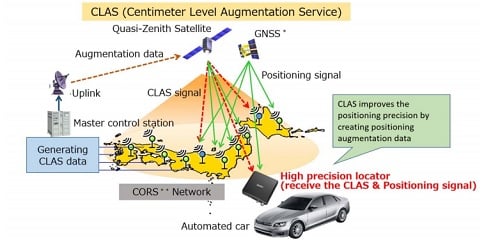
 Mitsubishi Electric Corporation has begun highway testing of what it claims is the world’s first autonomous driving technology to use a centimeter-level augmentation service (CLAS) broadcast from the Quasi-Zenith Satellite System (QZSS).
The driving tests will be conducted to verify the possibility of infrastructural driving, utilizing CLAS signals and high-precision 3D maps combined with Mitsubishi’s intelligent driving technology, such as millimeter-wave radar and cameras.
CLAS is a positioning service that is distributed free of charge in Japan from QZSS. It is set to begin operations in April of 2018 and is in the final stages of verification. Expected CLAS applications include safe-driving assistance and automated driving.
Global navigation satellite systems (GNSS) transmit satellite positioning information to navigation devices. GNSS is limited to within a few meters due to errors caused by satellite orbits, satellite clocks and satellite biases. Local environmental factors such as ionospheric and tropospheric delays also have an impact.
Mitsubishi says CLAS improves precision through augmentation data from a network of continuously operating reference stations (CORS). Data broadcast via the QZSS to high-precision positioning receivers in automobiles enable receivers to detect locations with centimeter-level accuracy.
