
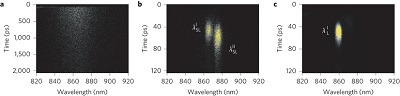
 Modulation of the ultrafast decay dynamics of multi-modal lasing by micrometer patch–patch coupling. Image credit: Northwestern UniversityResearchers from Northwestern University (Evanston, IL) have advanced the understanding and realization of multi-modal nanoscale lasing based on structural engineering and manipulating the optical band structures of nanoparticle superlattices. The technology enables control of light color and intensity by simply varying its cavity architecture.
Development of a laser design that outputs multi-color lasing could lead to encrypted, encoded, redundant and faster information flow in optical fibers, as well as multi-color medical imaging of diseased tissue in real time.
Available lasers bounce light between two mirrors and require time-intensive engineering to ensure that only one color — or wavelength — is emitted. Multi-color lasing output is only possible by assembling many single-color lasers. By use of superlattices, fabrication costs can be reduced by directly producing multiple, stable lasing peaks from a single device.
Nanoparticle superlattices are finite-arrays of metal nanoparticles grouped into microscale arrays. When integrated with a four-level gain system, the structures offer a platform to access different colors with tunable intensities depending simply on the geometric parameters of the lattice.
The researchers seek to design white nanolasers by covering blue, green and red wavelengths simultaneously. Their approach should allow them to change the “whiteness” by controlling the relative intensity of the blue, green and red channels.
