
Researchers at Jaypee University of Information Technology in India have developed a way to detect ‘copy-move forgery’ in photographs. The new method may be more successful and faster than methods currently in use.
Copy-move forgery is one of the more difficult forgery types to detect. It involves copying an object or area in an image and using it in another part of the same image. Usually, this is done to cover something up or add something that was not previously there. This technique can be used to hide critical data in a crime scene. An example of this is an image of three missiles being forged to look like an image containing five, with two of the missiles copied and added elsewhere in the picture.
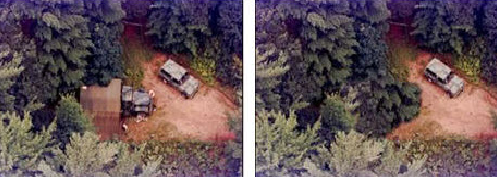 A copy-move forged image (Mehdi Ghorbani)
Copy-move forgery is difficult to detect because the altered parts of the photograph contain a similar palette, texture and distortions are the original images.
Approaches currently available to detect this type of forgery are slow. They involve a large number of computational calculations and can give false positive results.
The team of researchers developed an algorithm that translates each black pixel in the image into a position on a histogram. The copied parts of the image will have the same ‘profile’ in the histogram as the original object in the image, appearing as a repeated ‘valley’ in the histogram. Other objects will also have valleys, but they will not match other valleys.
The team successfully tested this method on more than 20 forged images of various sizes and found that there is an improvement in the computation time compared to other methods. This was especially true of larger images.
Currently, this technique is limited to images with a distinct contrast between copied objects and the image background, but researchers are hoping to expand this to all types of photographs.
This research was published in the Pertanika Journal of Science & Technology (JST).
