
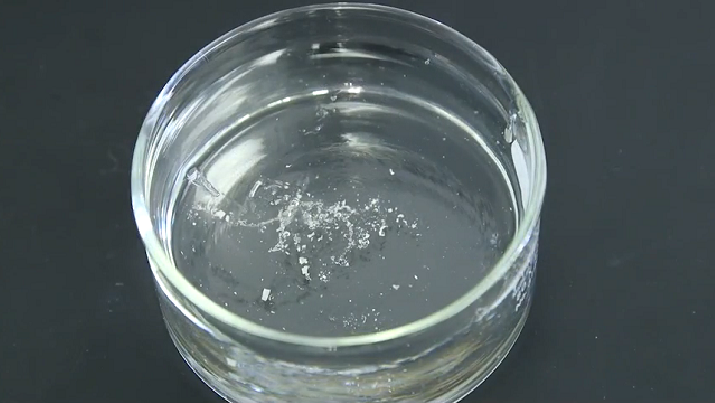
 Transient electronics in action. (Credit: Vanderbilt University)Researchers at Vanderbilt University are taking a unique approach to building transient electronics.
Using silver nanowires embedded in a polymer that dissolves in water below 32 degrees Celsius, mechanical and biomedical engineering assistant professor Leon Bellan and graduate student Xin Zhang made a simple circuit board. At present, it’s capable only of turning on an LED light – but the potential applications, for industries including healthcare and the military, are huge.
"Let's say you use this technology to make an RFID wireless tag," said Bellan. "You could implant important information in a person, and body temperature would keep it intact. If the tag were removed or the bearer died, it would dissolve. You could use it for implanted medical devices as well – to cause them to disintegrate, it would only require applying ice to the skin."
The paper represents an application of a technology Bellan developed in 2016. That year, Bellan showed how he could spin fiber networks comprised of capillary-like threads using a special polymer and a department store cotton candy-making machine. The threads could be embedded in materials that mimic the extracellular matrix and then be triggered to dissolve away – potentially producing capillary systems for artificial organs.
For the transient electronics application, silver nanowires are held together within the polymer close enough to touch and form an electrical conduit, similar to the traces on a circuit board. The tiny network stays operational in water warmed by a hot plate. When the heat source is turned off, the nanowire network disintegrates and the conductive path is destroyed.
“Once you start coupling that to a stimulus-responsive material, you start coming up with really sci-fi ideas," said Bellan. "You could have any cascade of events that results in a very unique stimulus that causes it to degrade or prevent it from falling apart. Temperature is just the beginning."
Integrating semiconductors to make transistors and ensuring users can interact wirelessly with the device are among the next steps.
