
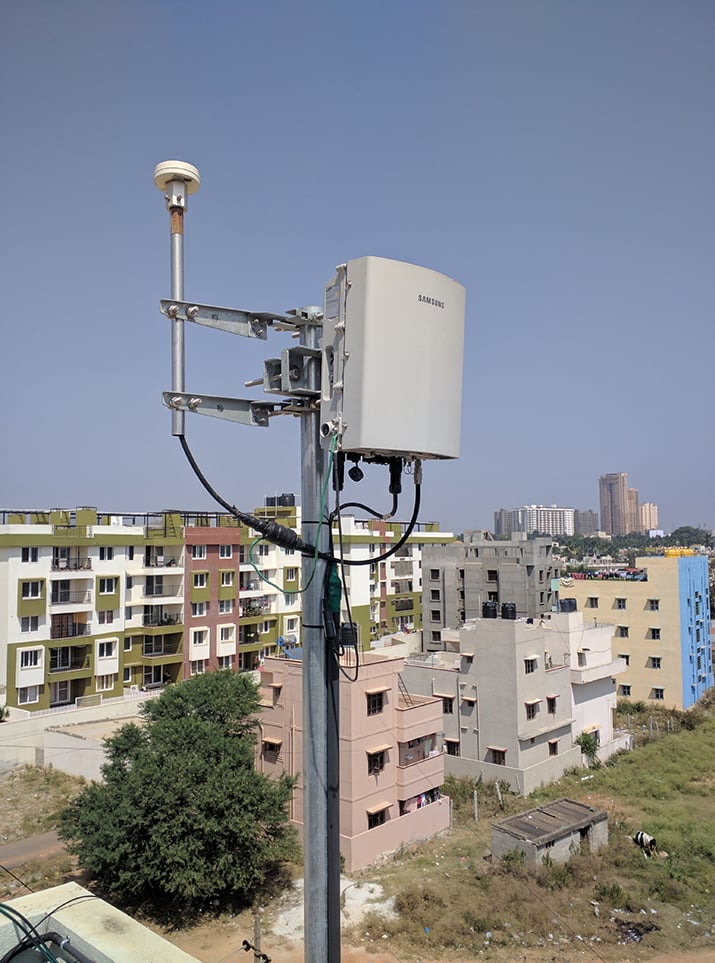
 Small cell situated in the terrace of a building in India. (Credit: Rohanmkth, via Wikimedia Commons)Democratic Minnesota Governor Mark Dayton has signed into law a new measure to streamline and standardize rules that will accelerate the deployment of small cell technology — an integral building block for 5G, the next generation of wireless technology.
Small cells are shoebox-sized antennas that will enable faster wireless internet speeds, provide targeted network capacity for services such as streaming movies or music, and lay the foundation for technologies of the future – 5G, smart cities, connected cars and devices. Because they can be affixed to existing structures such as traffic signals, buildings and street lights, they are designed to expand connectivity in a way that is both low-profile and unobtrusive.
Telecommunications conglomerate AT&T praised the move, saying that the legislation encourages companies to invest more in wireless infrastructure. Paul Weirtz, president of AT&T Minnesota, named Rep. Marion O’Neill and Sen. David Osmek, both Republicans, as instrumental in the establishment of the new law.
AT&T is enhancing its network in preparation for the “Big Game” — the 2018 Super Bowl, which will be played in Minneapolis. The company plans to add capacity to numerous existing macro sites and to submit hundreds of applications for city permits for small cells in the Twin Cities. AT&T has invested nearly $350 million into Minnesota networks during 2014-16. In 2016, the company made over 1,350 wireless network upgrades in the state, including the addition of new cell sites and adding network capacity to existing cell sites.
"The possibilities a 5G world promises are both limitless and exciting, and we want to make sure Minnesota is a leading state that welcomes and encourages investment in the latest super-fast wireless technologies," said Rep. Marion O'Neill. "This new law streamlines the process for wireless investment, helping to bring better wireless service to residents and businesses and positioning Minnesota to benefit from the 5G economy."
"With this new law, Minnesota now has forward-looking rules that maintain the local control permitting process and will also allow for the acceleration of the deployment of next-generation high speed wireless infrastructure in the state," said Senator David Osmek. "5G is the wave of the future and we want to make sure Minnesota is at the forefront of emerging technologies."
Wired Connectivity
Paving the Way for Small Cell Deployment in Minnesota
02 June 2017
Powered by CR4, the Engineering Community
Discussion – 0 comments
By posting a comment you confirm that you have read and accept our Posting Rules and Terms of Use.
Advertisement
Advertisement
Popular News
2.
Find Free Electronics Datasheets

Advertisement