
Researchers at Rice University are proposing an unexpected method for dealing with electronic waste: crush it into nanodust. This method would keep e-waste out of incinerators and landfills, where 80 to 85 per cent of the toxic trash ends up.
The new process creates a powder with particles so small that sorting components is relatively simple. The team uses a low-temperature cryo-mill to pulverize electronic waste—primarily the chips, other electronic components and polymers that make up printed circuit boards (PCBs)—into nanoscale granules.
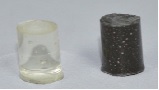 A transparent piece of epoxy, left, compared to epoxy with e-waste reinforcement at right. Courtesy Ajayan Research GroupConventional resource recovery methods heat electronic components and/or treat them with chemicals to release their constituent precious metals and other compounds. By chilling the e-waste to 154 kelvins (minus 182 degrees Fahrenheit), the materials’ basic properties change. The now-brittle materials are easier to pulverize and do not interact with each other, as is often the case when they are heated.
The experiment used the innards of computer mice as test subjects. The innards were placed in a cryo-mill with a tool-steel-grade ball and argon gas. Liquid nitrogen cooled the mill contents. When the mill is shaken, the steel ball smashes the contents—polymers, oxides, and metals—into particles between 20 and 100 nanometers wide. The process takes three hours.
The e-waste stream is expected to increase by 33 percent over the next four years, making it the fastest-growing waste stream in the U.S. Alternative recycling methods, such as the cryo-mill, could provide an efficient method breaking down this waste and recovering useful materials.
The journal Materials Today published the research report on March 20, 2017.
