
Traditionally, in order to enable two-way communication, individual send and receive circuits are needed. The idea to put them together in the same device requires a significant filter in order to provide signal isolation; transmit signals are much stronger than the receive signals.
Researchers at Cornell University have devised a method for both transmitting and receiving a radio signal on a single chip. The discovery could help change the way wireless communication is done.
While trying to separate the send and receive bands in radios is difficult enough, the problem is expanded with the ever-increasing number of bands in the latest devices such as GPS, Bluetooth and Wi-Fi, each requiring their own filer to stop the strong transmit signals from drowning out reception.
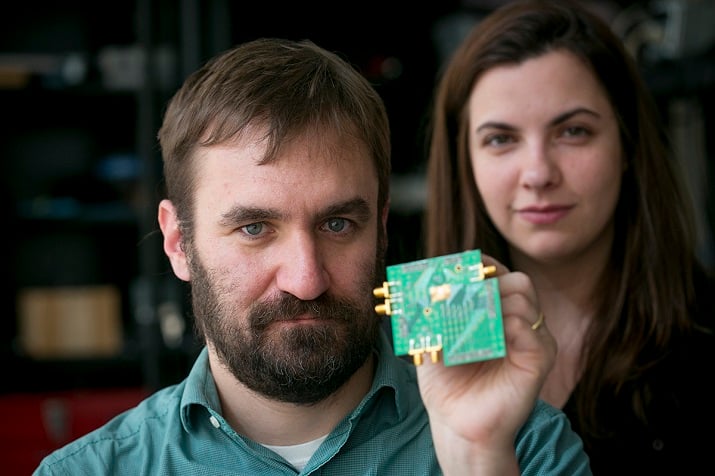 Alyosha Molnar, associate professor of electrical and computer engineering (ECE) at Cornell, holds a test board with a two-way transceiver chip mounted in the center. Source: Cornell University In order to separate the signals, Alyosha Molnar, associate professor of electrical and computer engineering (ECE) at Cornell, created a series of six subtransmitters all hooked into an artificial transmission line. Each sends a signal at regular intervals so that they combine to produce a radio frequency signal in the forward direction at the antenna port. At the same time cancelling out at the receive port.
Researchers say the programmability of the individual subtransmitters allows for simultaneous summation and cancellation to be tuned across a wide range of frequencies and to adjust the signal strength at the antenna.
The antenna is put at one end and the amplified signal goes out of the antenna and the receiver at the other end where the nulling happens. The receiver sees the antenna through this wire, the transmission line, but the transmit signal goes unnoticed because it is cancelled out at the end.
Unlike other attempts to build a two-way radio on a chip, the Cornell concept works over a range of frequencies by controlling different subgains of the transmitters that allow the cancellation to always happen. Instead of needing a filter for every band, signal separation can be controlled digitally. Upgrading to the latest version would be as easy as updating an app or downloading the latest software.

