
Researchers from Virginia Commonwealth University have developed a new method to create superatoms, moving one step closer to better batteries and semiconductors. Superatoms are combinations of atoms that can mimic properties of more than one group of elements on the periodic table.
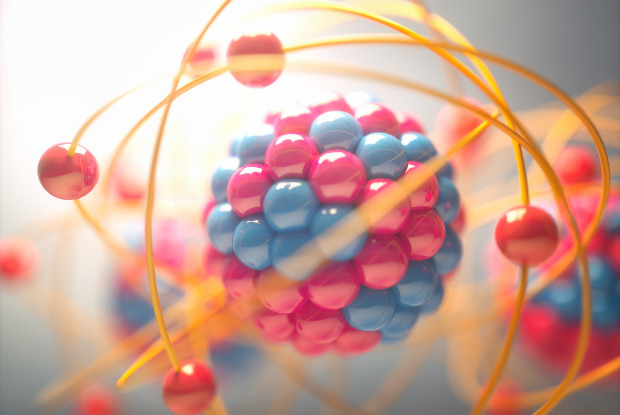 A rendering of protons, neutrons and electrons in an atom. Source: Virginia Commonwealth University
Batteries and semiconductors need to transition a charge from one group of atoms to another group of atoms. In this process, electrons are transferred from donor atoms to acceptor atoms. Superatoms must supply and accept multiple electrons at one time, while still having structural stability. This is required to create better batteries or semiconductors. Superatoms can move charges while staying intact because they mimic multiple properties of multiple element groups.
The research demonstrated a new method for building superatoms in order to produce effective energetic materials.
"Semiconductors are used in every sphere of life," said Shiv Khanna, Ph.D., professor and chair of the department of physics in the college of humanities and sciences at VCU. "Superatoms that could substantially enhance electron donation would be a significant societal benefit."
Alkali atoms live in the first column of the periodic table and, according to the researchers, are perfect for donating electronics. These atoms occur naturally and can be used to donate one electron with a low amount of energy. When these atoms are pushed to donate more than one electron, it requires a large amount of energy that could potentially destroy the atoms.
"The possibility of having these building blocks that can accept multiple charges or donate multiple charges would eventually have wide-ranging applications in electronics," Khanna said.
The team created the first effective method to create superatoms while maintaining low energy and no explosions. The researchers say organic liquids could improve electron exchange without compromising the energy levels of the atoms.
"We could use ligands to take any cluster of atoms and turn it into either a donor or acceptor of electrons," Khanna said. "We could form electron donors that are stronger than any element found on the periodic table."
The paper on this research was published in Nature Communications.
