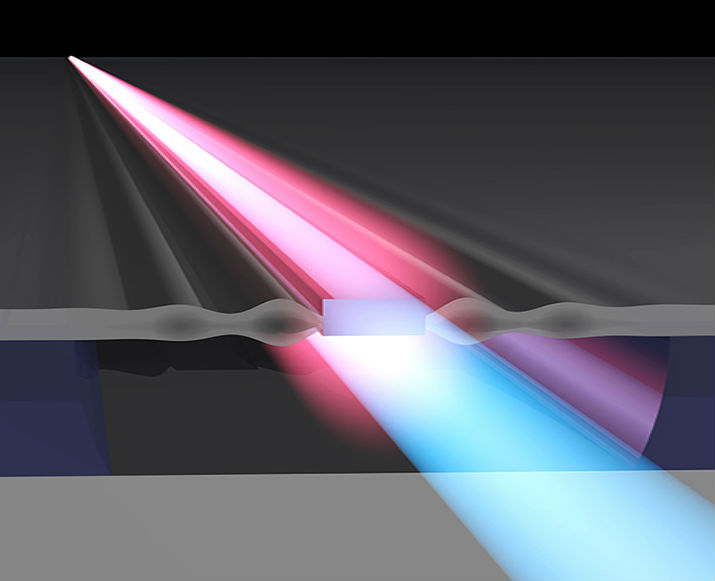
 New waveguide system that harnesses the ability to precisely control the interaction of light and sound waves. (Image Credit: Yale University) The Yale team, led by Peter Rakich, an assistant professor of Applied Physics and Physics at Yale, has developed a new waveguide system that harnesses the ability to precisely control the interaction of light and sound waves. This discovery contributes to a solution for the longstanding problem of how to utilize this interaction in a robust manner on a silicon chip as the basis for powerful, new signal-processing technologies.
“Silicon is the basis for practically all microchip technologies,” said Rakich. “The ability to combine both light and sound in silicon permits us to control and process information in new ways that weren’t otherwise possible.”
Rakich compares the two capabilities to “giving a UPS driver an amphibious vehicle—you can find a much more efficient route for delivery when traveling by land or water.”
Until now, any researchers that tried to implement the hybrid technologies onto a silicon chip have failed because the devices were not efficient enough for practical applications.
The Yale team overcame this challenge by using new device designs that prevent light and sound from escaping the circuits.
“Figuring out how to shape this interaction without losing amplification was the real challenge,” said Eric Kittlaus, a graduate student in Rakich’s lab and the study’s first author. “With precise control over the light–sound interaction, we will be able to create devices with immediate practical uses, including new types of lasers.”
The chips have a number of commercial applications, including fiber-optic communications and signal processing.
