While Wi-Fi is great at connecting all of our devices, the technology uses a lot of energy and can drain the battery life of those devices.
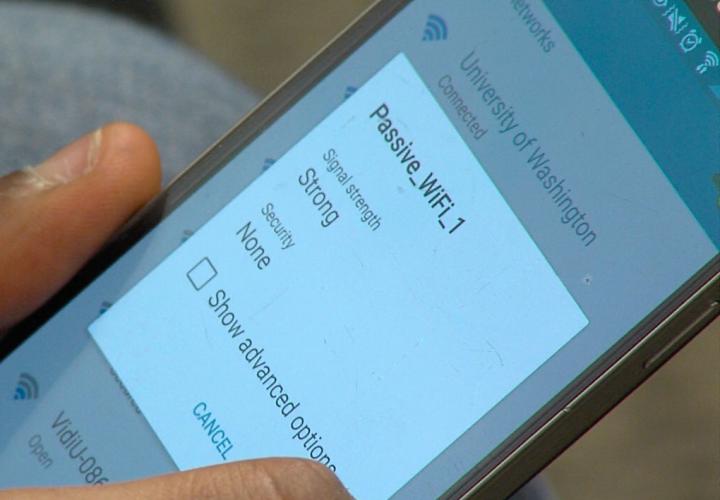 University of Washington computer scientists and electrical engineers have generated "passive" Wi-Fi transmissions that use 10,000 times less power than current methods. (Image Credit: University of Washington)
But now, computer scientists and electrical engineers from the University of Washington has figured out a way to create Wi-Fi transmissions that use 10,000 times less power than traditional methods. The new system, called Passive Wi-Fi, also consumes 1,000 times less power than existing energy-efficient wireless communication platforms like Bluetooth Low Energy and Zigbee.
"We wanted to see if we could achieve Wi-Fi transmissions using almost no power at all," said Shyam Gollakota, a UW assistant professor of computer science and engineering. "That's basically what Passive Wi-Fi delivers. We can get Wi-Fi for 10,000 times less power than the best thing that's out there."
Passive Wi-Fi can transmit Wi-Fi signals at bit rates of up to 11 megabits per second that can be decoded on any Wi-Fi connected device. While these speeds are lower than maximum Wi-Fi speeds currently recorded, they are 11 times higher than Bluetooth.
How they did it
In order to create the low-power transmissions, the team decoupled the digital and analog operations involved in radio transmissions. With Passive Wi-Fi, analog functions (which tend to be power-consuming) are all assigned to a single device within the network, which is plugged into the wall.
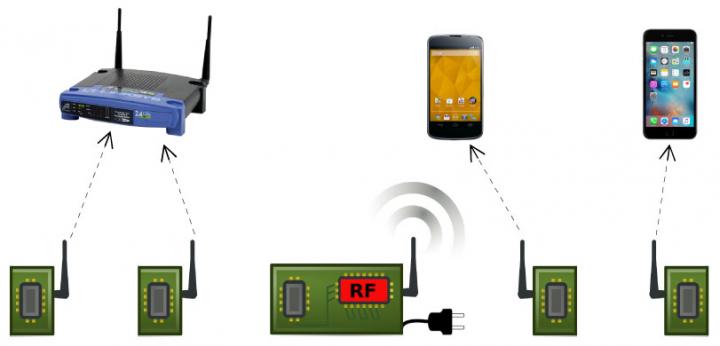 University of Washington computer scientists and electrical engineers have generated "passive" Wi-Fi transmissions that use 10,000 times less power than current methods. (Image Credit: University of Washington)
An array of sensors produces Wi-Fi packets of information using very little power by simply reflecting and absorbing that signal using a digital switch, which means they can sync with any Wi-Fi enabled device directly out of the box. "All the networking, heavy-lifting and power-consuming pieces are done by the one plugged-in device," said Vamsi Talla, an electrical engineering doctoral student. "The passive devices are only reflecting to generate the Wi-Fi packets, which is a really energy-efficient way to communicate."
The UW team found that the Passive Wi-Fi and a smartphone can connect at distances of 100 feet. The technology could potentially benefit the Internet of Things, connected devices, by consuming less battery life.