
A U.K.-based firm has developed a new uncrewed ground vehicle (UGV) that uses a passive navigation and perception architecture that combines cameras, thermal imaging and 3D vision to navigate its surroundings.
According to VisionWave, this is unlike the majority of existing ground robots, which rely on active radar, laser scanning, lidar or constant radio connectivity.
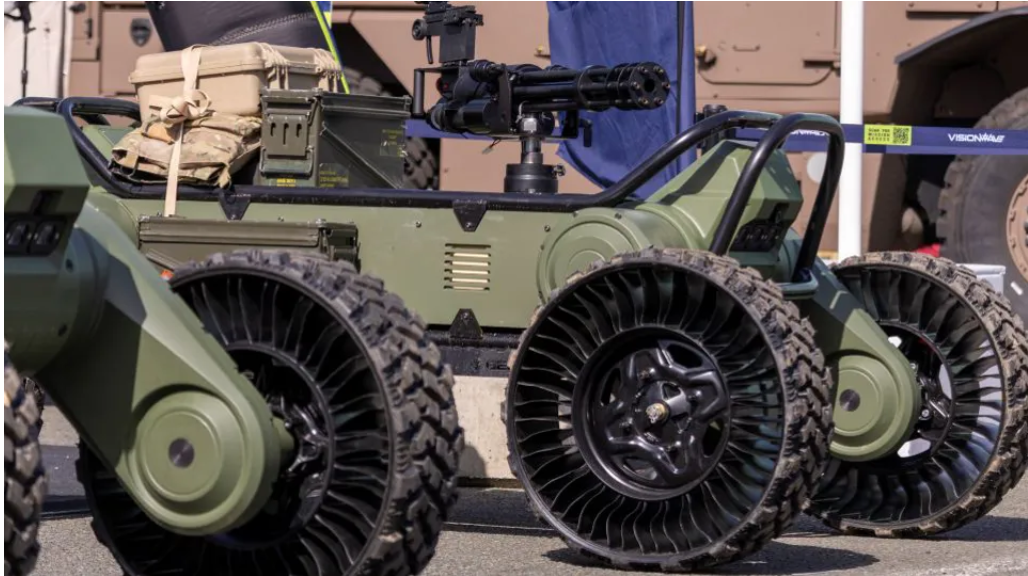 Source: VisionWave
Making its debut at the recently held global defense exhibition Eurosatory, VARAN is capable of planning routes onboard without the need for an operator link, enabling it to resume missions even when GPS signals are unavailable or communications are disturbed.
Further, the system minimizes detectable emissions by avoiding technologies that might reveal its position to hostile forces.
“VARAN's passive navigation and perception architecture has been developed specifically for operation in contested and GNSS-degraded environments, where reliance on traditional navigation aids may be limited or unavailable,” the team explained. “As with any perception-based system, environmental conditions such as dense obscurants, extreme weather or rapidly changing terrain can present challenges. For this reason, the architecture has been designed around sensor diversity and layered perception, combining visible-spectrum and thermal inputs to improve resilience across varying operational conditions.”
Thanks to its design, wherein a height-adjustable chassis is mounted on extendable wheel arms, the vehicle is able to automatically alter its stance based on terrain conditions, thereby enabling it to traverse rubble, water obstacles and uneven ground without operator intervention.
Further, VARAN can travel at speeds of up to 45 mph, climb gradients of 60%, negotiate side slopes of 40% and rotate via independently driven wheels. In the event that a wheel arm is damaged, the VARAN can resume operations and return under its own power, thus eliminating the need for recovery operations in contested areas.
VARAN also features dual-motor redundancy, real-time health monitoring and field-repairable components for supporting operations away from established logistics infrastructure.
“The design philosophy behind VARAN was fundamentally different from many existing UGV programs,” its developers noted. “Rather than optimizing purely for technical performance, the program prioritized operational simplicity, expeditionary sustainment and reduced logistics burden from the outset. We believe this approach offers significant through-life benefits, reducing training requirements, support costs and maintenance overhead while increasing operational flexibility.”
Capable of carrying payloads weighing up to 400 kg and towing more than 1,000 kg, VARAN can reportedly support multiple operational roles from a common chassis, including intelligence, surveillance, target acquisition and reconnaissance (ISTAR), air defense, counter-uncrewed aerial systems, casualty evacuation, logistics support, route clearance, force protection, electronic warfare support and forward observation.
