
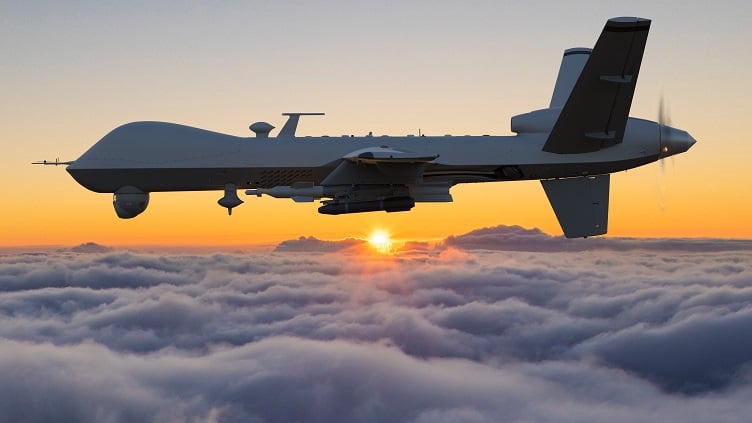
Wars of the future will likely be fought by machines. Specifically, battery constrained drones that must think. That’s where neuromorphic processors are playing a role in the next Department of Defense chapter to redefine the battlefield.
As shown in the last wars, both in Ukraine and in the Middle East, autonomous drones have already reshaped the battlefield. Countering these drones is as critical to developing unmanned systems that are cheap and powerful in their destruction.
The next generation of unmanned systems may face harder constraints than enemy fire: battery life and the ability to think on their own. However, the more processing power an unmanned aerial vehicle (UAV) or unmanned ground vehicle (UGV) demands, the heavier and short-lived it becomes.
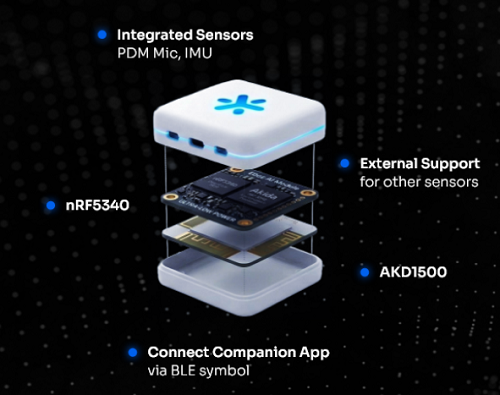 An inside look of the BrainChip Akida AKD1000 low-power AI accelerator processor used in the 2025-2026 Raytheon Autonomous Vehicle Competition. Source: BrainChipBecause of this, not having the right tradeoff could end in disaster. That’s why the DoD and Raytheon are moving toward neuromorphic processors. These semiconductors are designed to process data in a similar way to a human brain. The machines react only when something happens, reducing its energy consumption to milliwatts instead of watts.
Raytheon, along with neuromorphic processor vendor BrainChip, are collaborating to solve this problem with the 2025-2026 Raytheon Autonomous Vehicle Competition (AVC). This university led competition will see students build the next-generation of UAV or UGV using BrainChip’s Akida AKD1000 low-power AI accelerator processor built on the company’s Akida 1.0 neural network inference processor.
“The future of warfare belongs to the machine that can see, think and react without a tether,” said Sean Hehir, CEO of BrainChip.
Why traditional chips won’t work
According to Hehir, traditional processors require too much energy and physical space to provide high-level intelligence on small, mobile platforms like UAVs or UGVs.
These processors waste cycles waiting between events, burning energy quickly and then having to return to a docking station for recharge.
 Sean Hehir is the CEO of BrainChip. “Autonomous machines by definition need batteries, and they are a principal design challenge,” Hehir said. “Once the battery is dead, the autonomous machine is dead too. The more power a design uses, the larger the battery and the heavier it is to lug, reducing autonomous range.”
Neuromorphic processors, on the other hand, provide low size, weight, power and cost (SWaP), which is becoming critical in modern warfare, Hehir said. Neuromorphic processors detect only when events happen, allowing autonomous systems to stay in the field longer, remain undetected and operate with total independence, he said.
Neuromorphic chips can process sparse data streams for radar, lidar and sensors that produce irregular data bursts rather than steady frame rates.
The market for neuromorphic computing for the defense market is set to grow to about $9.7 billion by 2034, managing a compound annual growth rate (CAGR) of 20.5%, up from $1.8 billion in 2025, according to data from Market Intelo.
Overall, the drone market is expected to exceed $35 billion by 2030, Market Intelo said. Every drone platform under development will rely on AI-driven computer vision, a feature neuromorphic chips can deliver at a fraction of the power of conventional processors.
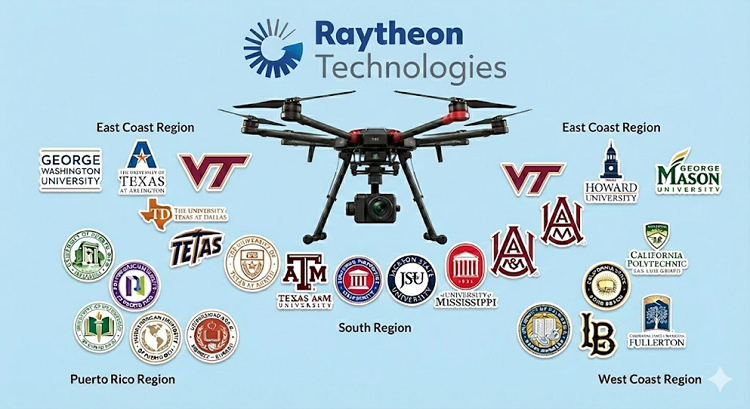 The universities that are participating in the 2025-2026 Raytheon Autonomous Vehicle Competition to build UAVs and UGVs based on Brainchip’s neuromorphic processors. Source: Raytheon
Operation Touchdown
Raytheon’s AVC theme is called “Operation Touchdown.” The competition will challenge students across four United States-based regions — South, Puerto Rico, West Coast and East Coast — to design and integrate neuromorphic collaborative systems into a UAV or UGV.
The program is designed to foster university relationships and cultivate the top talent from the U.S. They also get mentoring from Brainchip and Raytheon during the competition and then continue to work with the students on the design work once the competition is over.
BrainChip is providing students with its neuromorphic semiconductor technology, called Akida AKD1000, built on a 1.0 neural network inference processor used to develop these UAVs or UGVs.
“Rather than traditional classroom exercises, these competitions present students with actual engineering constraints,” Hehir said. “Students who participate develop a worldview in which defense work is rewarding and meaningful, and they acquire the applied skills needed for these industries. Many students go on to intern at the sponsoring companies as a potential career path which gives the companies a chance to further evaluate and mold them for full time position.”
The competition's signature challenge is as technically demanding as it sounds: Teams must autonomously land a UAV on a moving UGV — no human intervention, no remote guidance. Teams from four U.S. regions will compete to pull it off, with events already completed at the University of Texas at Arlington on April 16-17 and George Mason University in Washington D.C. on April 22-24. The last competition dates will happen at Santa Barbara City College in California on June 5-6 and a fourth region covering Puerto Rico.
