

Fixed wireless access (FWA), also known as cellular broadband, is surging in popularity among consumers.
A recent survey from J.D. Power found that consumers see FWA as an increasingly better value than fiber optic and cable internet. Additionally, the technology, which uses cellular technology for broadband, has a higher rate of satisfaction compared to these other broadband technologies. As a result, FWA has grown by 47% to 11.8 million subscribers in the U.S., according to J.D. Power.
And that is just the beginning. According to market research firm Omdia, global 5G FWA subscriptions are set to more than double by 2030. Omdia forecasts FWA subscriptions to grow to 150 million by 2030, up from 71 million worldwide in 2024, with the U.S. being the largest market for the technology.
Overtaking DSL
Omdia forecasts that 5G FWA will surpass 4G FWA by 2027 and is on track to overtake DSL as the world’s third-largest broadband technology.
As cable subscriptions decline in the next five years, FWA is positioned to become the second most common broadband access technology post-2030 with total FWA service revenues rising to $46 billion by 2030, Omdia said.
“We’ve been the fastest-growing internet provider for 13 quarters in a row, and that’s no accident,” said Brad Stamulis, VP of broadband marketing at T-Mobile.
Verizon and T-Mobile have been champions of fixed wireless access since the early days of 4G LTE and then later in 5G. America’s third telecom, AT&T, has been ramping up its support for its FWA as well since it became a feasible technology.
“We’re giving customers a real alternative to traditional broadband and it’s resonating,” Stamulis said. “That’s why J.D. Power also ranked us #1 in customer satisfaction for national home wireless internet service, a recognition that builds on their article showing fixed wireless is leading the way in customer satisfaction.”
T-Mobile has nearly 7 million FWA users today and plans to reach 12 million by 2028. While being an alternative is certainly a big part of FWA’s growth, it is just a starting point for this technology that is likely to be a full-blown broadband contender in the future.
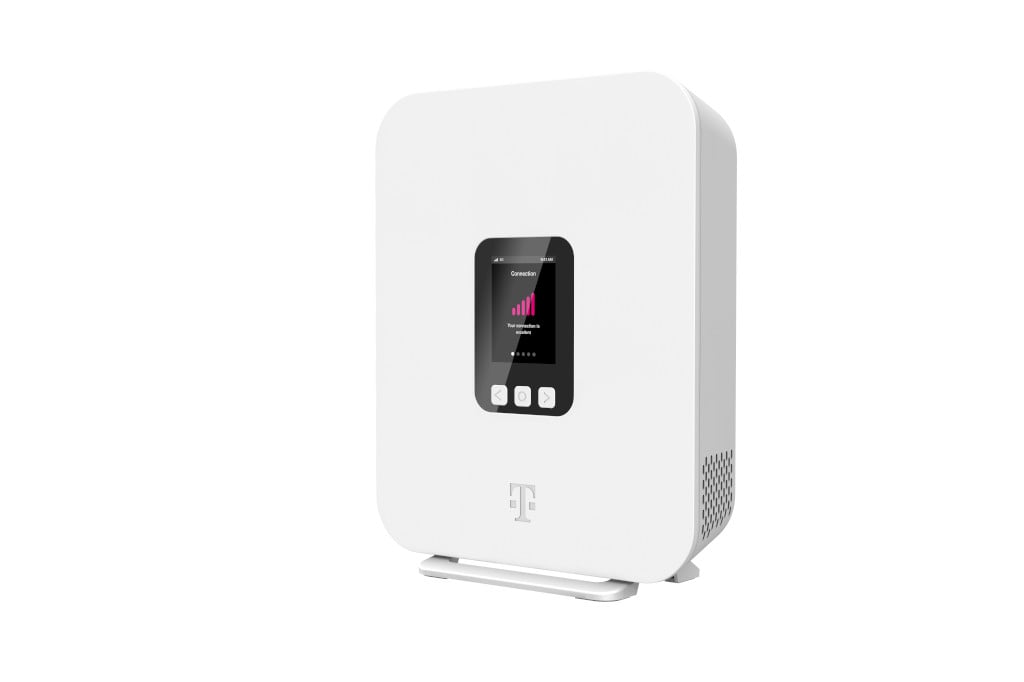 T-Mobile’s 5G Gateway enables fixed wireless access inside homes providing broadband connections equal to fiber or cable. Source: T-Mobile
Alternative options
One of the important growth drivers for FWA is that it is an alternative option to traditional fiber and cable broadband.
“If you live in an urban area, you likely have a few options for broadband,” said Phil Solis, research director for client processors and connectivity at IDC. “But in rural areas, they likely have only one choice, or no choices at all and must used satellite connectivity. FWA changes broadband options for everyone.”
In dense urban areas, telecoms may be offering better cost competition compared to cable or fiber. Adding more competition benefits consumers with multiple choices for internet access in the home.
In rural areas, which likely used satellite connectivity previously, it is a faster option, but the wireless technology might be spotty at times.
“FWA represents one of the clearest real-world validations of what 5G was designed to achieve: high-speed, low-latency, reliable wireless broadband that can compete directly with wired infrastructure. It’s also a critical tool in addressing the digital divide,” said Stan Gray, senior VP of IoT broadband and high cat vertical sales at Telit Cinterion, an IoT module and connectivity vendor. “Many communities still lack access to modern internet services due to the high cost and complexity of deploying fiber or cable. With FWA, network operators can reach these markets quickly and affordably.”
Ease of use
Another major reason for FWA access growth is that it requires no cables, does not require a technician to install the technology and there is no drilling or punching holes in walls to support installation.
“The convenience is a huge draw,” Gray said. “Setup is typically as easy as plugging in a pre-configured device, where connectivity is then available almost immediately. On top of that, 5G technology now provides multi-gigabit throughput, low latency and high reliability — performance that rivals and commonly surpasses legacy broadband.”
This coupled with the cost-effectiveness of avoiding physical wiring becomes an attractive option for both urban customers looking for alternatives and rural or underserved areas that only other alternative might be satellite, Gray said.
“The added flexibility of using 5G also turns FWA into a resilient solution for backup and failover scenarios,” Gray said. With multi-gigabit throughput now possible via sub-6 GHz 5G — plus growing coverage across the world — FWA is a compelling, flexible and future-ready modern broadband solution.
 FWA is on track to become the third largest home broadband service by 2027 overtaking DSL in the sector. Source: T-Mobile
FWA’s 6G future
While 6G is likely to begin deployment toward the end of this decade, it will majorly impact the role of FWA.
First, it will expand high-speed internet access and coverage in these rural and underserved areas to help bridge the so-called digital divide. But by leveraging the ultra-fast speed, ultra-low latency and superior bandwidth of 6G, FWA will likely move beyond just consumer home use and into industries, according to the Next G Alliance.
It is altogether possible to see FWA in applications like:
- Gaming
- Telehealth
- Public safety
- Education
- Smart factories
- Industrial automation
Additionally, the adoption of millimeter wave (mmWave) and future spectrum allocations — which likely won’t appear commercially until 6G is deployed — will further add to FWA’s reach.
“It’s still early days for 6G, but we’re always looking ahead at how we can deliver an even better experience for customers,” Stamulis said. “Fixed wireless has already proven to be a meaningful alternative to traditional broadband, and its potential only grows as wireless networks evolve with faster speeds and more capacity.”
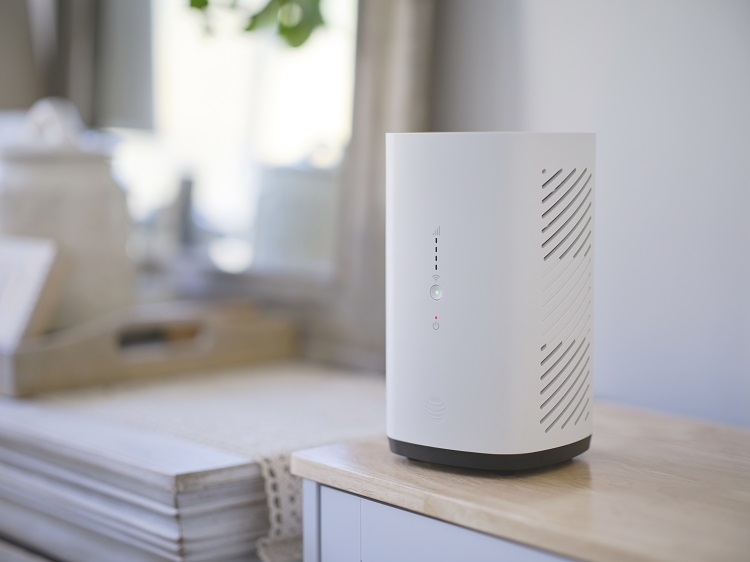 AT&T’s Internet Air gateway is the module used for FWA from the telecom. The technology is billed as a companion to AT&T’s fiber service, however, FWA may play a larger role moving forward for the company. Source: AT&T
Big deals
Due to the growing popularity of FWA combined with diminishing returns in the cellular subscriber base and smartphone sales, telecoms are now pursuing FWA in a major way. Even making billion dollar deals to gain spectrum.
“Because subscriber growth is flat now and the market is saturated — almost everyone has a smartphone or even multiple phones,” IDC’s Solis said. “Telecoms realize they are not going to grow much more doing the same thing. And they certainly can’t charge more for the phones or services. So, telecoms are trying to go into IoT and broadband where they see potential growth.”
AT&T Internet Air AIA has more than 1 million users, but that number is likely to grow substantially in the future.
“We’re seeing strong growth and positive reception for our consumer fixed wireless 5G home internet product (AIA),” an AT&T spokesperson said. “It effectively meets consumer needs across a variety of situations and is a complement to our fiber internet product.”
While viewed as complementary for now, moves by AT&T may not keep it as just a complementary product in the future. In August of 2025, AT&T spent $23 billion to acquire about 30 MHz of nationwide 3.45 GHz mid-band spectrum and about 20 MHz of nationwide 600 MHz low-band spectrum.
AT&T said the licenses cover 400 markets in total in the U.S. The company will deploy mid-band licenses — which are compatible with its 5G network — as soon as regulatory approvals are met.
With the added spectrum from the EchoStar deal, the expansion of FWA services will be offered into even more regions.
 FWA access is surging for several reasons: Ease of use, alternative to current broadband technologies and bringing broadband to underserved areas of the U.S. Source: AT&T
Big plans
While telecoms are betting big on the future of FWA with the forecast more than doubling in the next few years, these companies are already ramping up how to entice customers to the platform.
According to T-Mobile’s Stamulis, freebies and perks are also becoming a norm.
T-Mobile offers no contracts, quick installation, unlimited data and even some cybersecurity options.
As FWA access grows, there will be even more bundles coming. Already telecoms are experimenting with bundling streaming services with FWA subscriptions. This could be anything from Hulu or Disney+ or Paramount+. This could benefit both the telecoms and the streaming services that are rife with ever-increasing competition for views.
Obviously, a natural bundle would be mobile smartphone service with FWA but the market could see bundles that include price lock for a given time — 5 years or even longer — to give customers a stable rate and the telecoms a stable revenue.
“Some people are tired of the traditional internet experience of contracts, equipment fees and yearly price hikes,” Stamulis said. “Others may not even realize there’s another option available with FWA, so it’s all about continuing to drive awareness of T-Mobile’s differentiated experience.”
There are even more bundles coming as well. Smart home technology is a technology that continues to evolve, and broadband connectivity is at the heart of all smart home technologies. A natural fit would be to include mesh security networks with a FWA subscription or actual devices that are connected via FWA that users are likely to have in their homes already or were looking to purchase.
Additionally, FWA are expanding beyond just residential services. FWA is increasingly being adopted by small businesses, pop-up locations and backup services for enterprises and public safety deployments.
“As the ecosystem matures and 5G modules become smaller, more power-efficient and more cost-effective, FWA will only become more deeply embedded in how broadband is delivered — not as an alternative, but as a new standard,” Telit Cinterion’s Gray said.
