
Forget the hype in drone technology about energy density and sensor resolution. The most decisive breakthroughs are happening elsewhere, within the radio spectrum. Radio frequency (RF) has graduated from its role as a silent enabler of basic remote control, into a command center that governs how drones truly sense, think and secure their place in the sky.
This represents a fundamental redesign. The next generation of drones, or unmanned aerial vehicles (UAVs), is being reimagined from the inside out to be smart, spectral-aware partners. And their success hinges on a new core capability to sustain resilient, low-latency communication while intelligently negotiating the world’s most contested, noisy and rigorously regulated airwaves.
Control link to cognitive network
The evolution has been dramatic. Early drones relied on a single pilot, a single control link and a solitary slice of band space. Their modern counterparts are sophisticated, multilayered systems where different radio links are meticulously tuned for distinct missions:
- Low latency telemetry for the flight loop
- High bandwidth channels to stream imaging data
- Secure broadcast layers that act as digital license plates for airspace accountability
Above these, cellular or mesh backhaul links connect fleets to the cloud and allow for distributed autonomy and coordinated missions. In fact, research in RF fingerprinting shows that unique transmitter artifacts (hardware imperfections in the RF chain) can be used to identify individual UAVs with accuracies above 90% in test settings. Functioning as both a sensor and an authentication layer, the drone’s communication link now delivers critical intelligence alongside core continuity.
Architecting for beyond visual line of sight resilience
The defining achievement in drone operations will be the mastery of routine beyond-visual-line-of-sight flight. For engineers, this means solving the critical challenge of building communication systems robust enough to conquer vast distances, navigate complex terrain and withstand severe weather.
Conventional cell towers, it turns out, are poor companions for drones. According to a 2025 analysis, the very architecture of cellular networks is holding drone aviation back. Base stations designed for ground users create a connectivity ceiling, causing a steep drop in uplink performance the moment a UAV flies above the tower's beam tilt zone.
To solve this, engineers are weaving together RF telemetry with adaptive cellular backhaul to sustain reliable long-range flight. The key is intelligence. Cognitive radios continuously scan their environment, instantly shifting frequencies to dodge interference and maintain a stable connection. This dual link architecture, which pairs unbreakable control with powerful data pipes, transforms the drone into an agile spectrum negotiator capable of surviving in congested and degraded environments where static networks would simply fail.
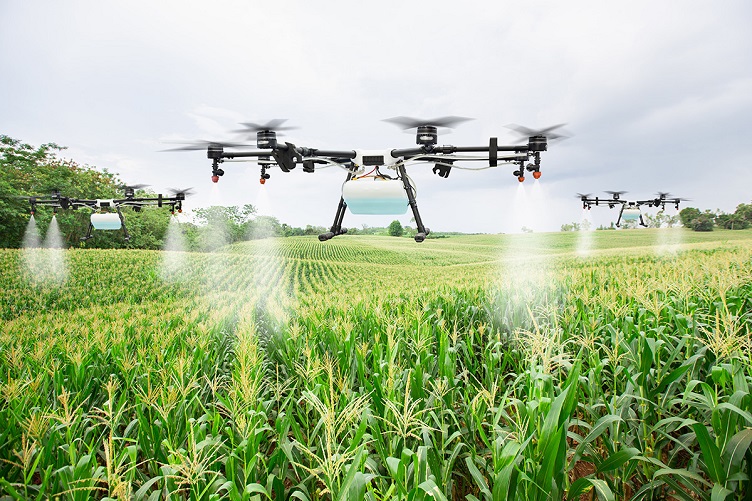
 When BVLOS becomes an operational reality, drones will be used for agricultural monitoring, energy infrastructure, emergency communications networks, environmental surveillance and more. Source: Adobe Stock
Rise of cognitive and collaborative RF systems
Next generation drone architectures exhibit behaviors once reserved for software systems by learning, sharing and adapting through radio. Mobile ad hoc networks (MANETs) allow fleets to establish peer-to-peer links where each drone acts as both node and relay. Data propagates across the swarm to form a self-healing mesh that survives signal obstruction or node loss.
Recent work demonstrated that large scale drone swarms can withstand deliberate jamming while preserving stable RF coordination using adaptive routing and cooperative beamforming. Such experimentation validates what engineers have long theorized. Drones can dynamically restructure their communication networks in flight to redistribute spectral resources for connection integrity. In civilian contexts, such systems are already shaping agricultural mapping, infrastructure inspection and emergency response where connectivity must rebuild itself faster than it can fail.
Security advances are following close behind. RF fingerprinting has matured into a reliable authentication tool that exploits unique, unclonable imperfections in a transmitter’s analog circuitry as a physical ID. Recent research revealed a powerful shift. The oscillator drift that once crippled system synchronization can now be stabilized and harnessed. A fundamental design flaw can be used to unique advantage. By using a stabilized drift as a physical fingerprint, a drone’s signature can act as both an unforgeable cryptographic key and a live diagnostic monitor of the network’s operational health.
Expanding the spectrum
The next chapter of drone communication reflects a convergence of RFP and cellular technologies. As 5G matures and the 3GPP Release 18 standards finally include direct support for UAVs, drones can leverage network slicing to isolate drone flight commands from other data on the network. This means a drone’s vital signs always get through instantly and the telemetry keeps its ultra-low latency no matter how many people are streaming videos below.
Manufacturers are moving quickly to operationalize these frameworks. Take Qualcomm's Flight RB5 5G platform, a purpose-built system that weaves cellular modems and short-range RF into a single, smart communication fabric. The design executes an elegant division of labor. It keeps critical flight controls on a sturdy sub-6 GHz link while offloading massive video and sensor streams over 5G or Wi-Fi 6E. Such a strategy optimizes both battery life and data speed and signals a profound change in how we think about drones. They are no longer solitary vehicles, but active partners in a federated network, intelligently balancing traffic across the best available frequencies and carriers in real time.
For long range or off-grid missions, satellite RF links are filling the coverage gaps. Companies like Iridium and Starlink have introduced UAV compatible data modules that deliver real-time telemetry and video where terrestrial networks cannot reach. This hybridization creates a powerful, multilayered connectivity model where robust RF is used for local control, 5G supports high bandwidth backhaul and satellite becomes a redundant global safety net. The drone becomes a roaming endpoint in a planetary network, sustained by intelligent spectral agility rather than just brute power.
RF sensing and navigation
As these networks grow denser and more intelligent, the same RF technologies sustaining communication are beginning to define perception itself.
Drones are now using radio waves to position and perceive themselves. Modern systems have moved beyond the strict dependence on GPS. Instead, they tap into the RF signals already around them to figure out where they are and what’s nearby. By analyzing multipath reflections and channel state information, drones can piece together a picture of the terrain, detect obstacles and keep their bearings even in GPS denied environments.
Pioneering research has unlocked a new form of navigation for GPS denied environments. A technique known as RF-SLAM allows drones to find their way through complex spaces, like warehouses and subways, with sub-meter accuracy by reading the ambient Wi-Fi and cellular signals. By interpreting signal strength, phase and timing, the system constructs a spatial map in real time. The drone can essentially see through walls and around corners to create a unique form of situational awareness that optical sensors can’t replicate.
The logical result of this trend is a technology called Integrated Sensing and Communications (ISAC), where a single radio signal does two jobs simultaneously. Studies reveal that drones can achieve centimeter level object tracking by embedding radar style pings within their standard data streams. In this model, every transmission doubles as a scan. This fundamentally blurs the line between networking and perception where drones can read the environment from the echoes of their own communication signals.
Applications
The convergence of these technologies is changing BVLOS into an operational reality.
Agricultural monitoring: RF-optimized drones equipped with low-latency telemetry and 5G data streams can autonomously survey thousands of acres, capturing continuous imagery and soil analytics across wide terrains without pilot oversight.
Energy infrastructure inspection: Power utilities now deploy long-range, RF-hardened UAVs to patrol pipelines and transmission corridors, transmitting high-definition inspection data to control centers hundreds of miles away.
Emergency communication networks: Mesh-networked drones are being fielded as temporary aerial relays in disaster zones, reestablishing connectivity for first responders.
Environmental surveillance: BVLOS platforms equipped with RF sensing arrays are mapping coastal erosion and flood zones, feeding critical data to environmental monitoring agencies for early intervention.
Defense and security operations: Military research programs are developing cognitive swarm systems in which drones share intelligence and autonomously adapt to jamming or interference, maintaining security under contested conditions.
Each of these use cases has communication integrity in common. True autonomy is defined by a drone's ability to maintain command, stream data and authenticate itself reliably, all beyond the pilot's direct view. The next evolution moves drones from being mere consumers of radio waves to active participants in the spectrum economy, where they will dynamically negotiate for bandwidth, sense congestion and migrate to cleaner channels to preserve their vital links.
Conclusion
The physics of flight has been mastered. The remaining obstacle to true autonomy is a drone’s ability to communicate intelligently. The ultimate breakthrough lies in spectral agility. A drone’s capacity to perceive its environment, authenticate its identity and maintain critical links defines its intelligence.
The future of unmanned systems will be governed by this new literacy. Success will belong to the drone that communicates with a deep, intuitive understanding of the invisible spectrum. This may be the final step in the evolution of autonomous machines. It completes their transition from sophisticated tools to truly independent agents, capable of securing their own presence and purpose in a contested environment.
