With a deep understanding of the latest digital trends and technologies, Max Chan, chief information officer, Avnet, leads all aspects of information technology (IT), including cybersecurity, digital strategy and transformations that position Avnet as a digital-first organization. Chan oversees the resources and capabilities of the global IT team, ensuring the organization maintains a robust and optimized IT environment.
Most businesses couldn’t operate without information technology (IT) equipment. Personal computers heralded a new dawn in productivity, with spreadsheets being perhaps the most impactful revolution.
The basics of those software applications haven’t changed in decades, and that’s not accidental. People are most productive when they use familiar tools. Nothing could be more familiar than basic office applications, email and web browsers.
 Max Chan is the chief information officer at Avnet. But all these tools, without exception, are undergoing revolutionary change, thanks to artificial intelligence (AI). And it is happening at every level, not just in the corporate world. Anyone who uses a web browser is experiencing AI-assisted searching that delivers more nuanced results. The search term is more closely examined using generative AI to trigger multiple searches in parallel, and the results are fed through another generative AI model to provide a concise but thorough summation of those results.
The big difference is that we no longer look at search engine results in a linear way, from individual sources. The search results are aggregated into a single response that sounds more balanced, more considered and more human.
If we look at the overall experience, user behavior is clearly changing. We now construct search queries using natural language, rather than pure intent. Doing that before AI would have resulted in unpredictable results, as the search algorithms were predominantly written to provide fulfillment orders. Today, we can pose questions, rather than simple requests, and we receive considered opinions, rather than purchasing recommendations.
Human behavior is changing to accommodate AI in search, but in commerce, technology must be more compliant. Change at that level is a complex and difficult process. It can be met with resistance, and in a business environment, that can be detrimental to performance. But AI is now a fact of life, and it will permeate and reshape the IT industry at every level.
AI integration in IT
Introducing AI into business processes has already started. Today, we’re seeing the public face of AI in the form of generative AI platforms and AI-powered web searches. We can and are using ‘out-of-the-box’ AI tools in business to help people execute work tasks faster.
These tools work in parallel with standard IT software, but we’re already seeing some integration. More of the tools we license from suppliers are being augmented with AI capabilities. Often, the AI features are provided at no extra cost, accelerating their introduction. Ultimately, suppliers will need to see a return on their investment, and that may incur additional fees or higher licensing costs.
This inevitable financial cost must be factored into any AI adoption strategy. Balancing cost versus the benefits is second nature for senior management teams, but the cost of accessing cloud-based AI features may require greater operational discipline.
Importantly, these early AI integrations are designed to work seamlessly, with little or no imposition on the user to change their behavior. AI can improve performance while maintaining continuity. This stage will be critical to the successful integration of AI into businesses.
Although we know AI is a disruptive technology, its implementation will be softened through controlled and gradual integration. Looking further ahead, we can begin to imagine how AI will be used even more impactfully.
For example, at Avnet, the use of AI has reduced operational expenses and manual intervention. More importantly, AI also brings greater accuracy and detail, with improved data classification and description accuracy, advanced search features and enhanced product recommendations.
The post-AI supply chain
Using AI as a force multiplier will generate higher productivity within existing processes. As we integrate AI into the IT domain, it will redefine how we implement those processes. As AI becomes more familiar, we will be prepared to develop new processes that are AI-oriented from conception.
The processes we use today, such as quoting and sales order processing, as well as delivery and stock management, exist to support the established supply chain flow. Avnet follows the SCOR (supply chain operations reference) model. This model, accepted across the industry, includes processes for order fulfillment and allows distributors to offer flexible solutions (e.g., in-plant stores, out-plant stores, and vendor-managed inventory).
Our customers need to balance their customer demand against inventory costs. Time spent monitoring inventory levels is an expense that AI could make unnecessary. Avnet’s Just-in-Time (JIT) programs are already integrated with its different supply-chain services. Our point of use replenishment system (POURS) model sits at the production line, triggering actions to move inventory from a central location to a local or on-site warehouse and down to the production line. The data captured in POURS, coupled with customer forecasts, determines stocking levels and initiates pipeline orders.
 AI will integrate into the supply chain at multiple points, bringing greater consolidation and context to data. This integration will redefine the way supply chain services are delivered. Source: Avnet
Adding AI to this flow will make it more efficient. As we move into a post-AI landscape, we can expect some or all of these processes to change. The current structure has resilience built into it, but every time stock moves, it incurs time and cost. Reducing that movement makes the supply chain more efficient, but we can’t do that at the cost of resiliency. As AI in the supply chain matures, we will be able to maintain or even increase supply chain resilience while redefining the processes involved, yet still complying with the SCOR model.
AI goes beyond technology
It’s important to recognize that AI isn’t just about technology. There is a close relationship between our people and the company culture, the technology, and the need for governance. For example, Avnet is putting AI in the hands of its people to enable them to benefit from this powerful technology. But we are taking a responsible approach through training and collaboration.
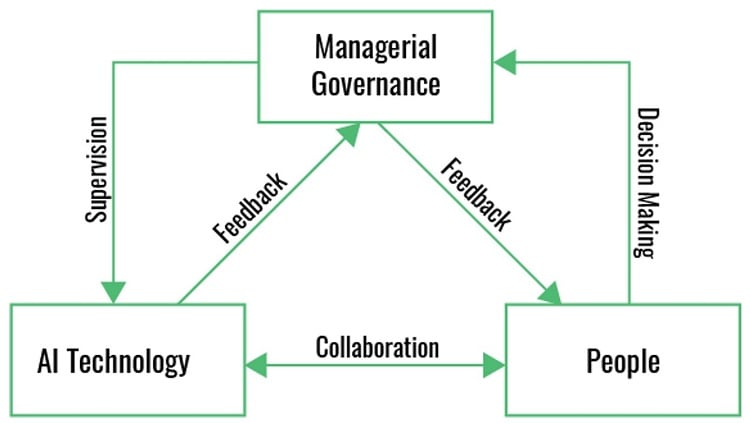 Introducing AI into an existing workflow will take careful consideration and cooperation with the organization’s people. Source: Avnet
Distributors can use AI to enhance its key capabilities, including supply chain as a service (SCaaS), inventory management and engineering design support. AI will transform not only the business but also how customers interact with it. This level of transformation comes with many challenges; therefore, it is critical for companies to work hard to ensure that they approach AI integration without compromising security, privacy or data quality.
Improving business processes was the focus for early software engineers, but in doing so, they also defined the standard for generations. AI presents us with a blank sheet to not only imagine but also implement a disruptive approach. We have an opportunity to redefine entire industries using artificial intelligence. By looking as far upstream and downstream as possible, we can imagine how the supply chain will be restructured to improve existing activities and create new business opportunities.
