
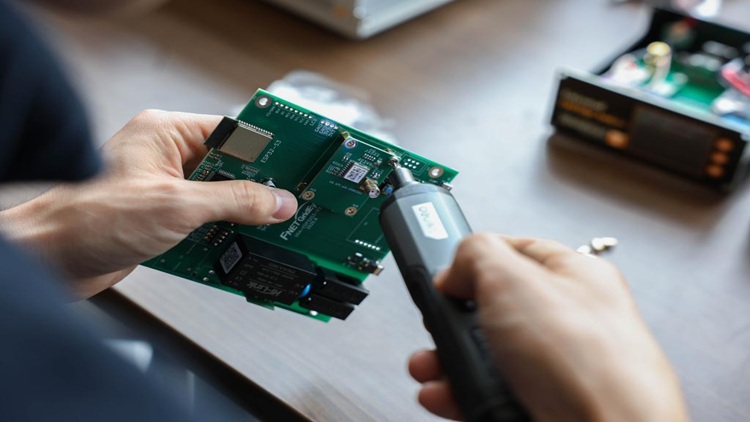
The need to stabilize and maintain power grid capabilities has become more urgent as power demand by data centers surges and renewable energy sources contribute to electricity supplies. Real-time insight into electric grid behavior can now be gauged with a compact sensing device developed by U.S. Oak Ridge National Laboratory (ORNL) and University of Tennessee researchers.
The Universal GridEdge Analyzer is based on the FNET/GridEye grid frequency monitoring network, which currently boasts 200 sensors across the U.S. and about 100 more worldwide that collect and transmit aggregated data for a broad overview of grid activity. With the advent of the new analyzer, more detailed information can be delivered at faster speeds, capturing incidents that earlier technology would have missed. The sensor can be embedded in power electronics or installed on a distribution line.
Any change in electrical voltage and current is recorded as waveforms, after which the data are instantly compressed, encrypted and streamed to centralized servers. The system can process 60,000 measurements per second — far more than the previous technology — and capture split-second reactions from power electronics that help run grids.
At artificial intelligence data centers, minor voltage fluctuations can trigger a switch to backup power, requiring immediate action to control the energy load. The analyzer can be deployed to help operators anticipate and navigate these episodes to maintain stable operations.
