A team of scientists from École Polytechnique Fédérale de Lausanne (EPFL) is building robotic devices that feature discarded crustacean shells, thereby leveraging the strength and flexibility of natural materials for robotic applications.
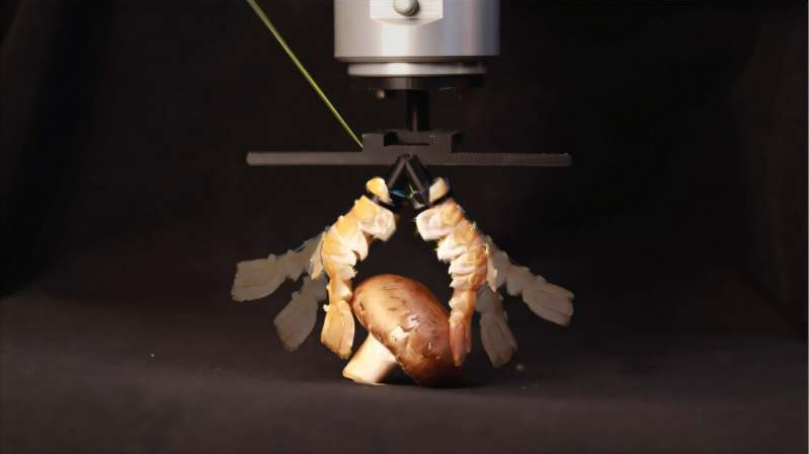
Specifically, the team built a robotic manipulator that features a pair of langoustine abdomen exoskeletons, explaining that combining biological elements with synthetic components could potentially enhance robotics and also support sustainable technology systems.
 Source: EPFL
"Exoskeletons combine mineralized shells with joint membranes, providing a balance of rigidity and flexibility that allows their segments to move independently. These features enable crustaceans' rapid, high-torque movements in water, but they can also be very useful for robotics. And by repurposing food waste, we propose a sustainable cyclic design process in which materials can be recycled and adapted for new tasks," the team explained.
Langoustine abdomen exoskeletons were modified with synthetic components to create three bio-hybrid robots: a 500-g-capacity manipulator, flexible grippers and a swimming robot.
The team embedded an elastomer within the exoskeletons to control each of their segments and then mounted the exoskeletons on motorized bases to modulate the exoskeletons’ stiffness responses (extension and flexion). The exoskeletons were then enveloped in a silicone coating to reinforce it and extend its lifespan.
The team explained that when mounted on the motorized bases, the robotic devices can move an object weighing up to 500 g into a target zone. When mounted as a gripping pair, two exoskeletons can grasp assorted objects that range in size and shape — for instance, from a highlighter to a tomato. Additionally, the system can even propel a swimming robot outfitted with two flapping exoskeletal "fins" at speeds of up to 11 centimeters per second.
The work is detailed in the article, “Dead Matter, Living Machines: Repurposing Crustaceans' Abdomen Exoskeleton for Bio‐Hybrid Robots,” which appears in the journal Advanced Science.
For more information, watch the accompanying video that appears courtesy of EPFL.
