
Researchers at Texas A&M University have developed a ball-like robot that could potentially map the moon’s terrain and send data back to operators.
The so-called RoboBall is a “perfect sphere” that cannot flip over, making it capable of navigating diverse environments — from the bottom of lunar craters to the shifting sands of a beach.
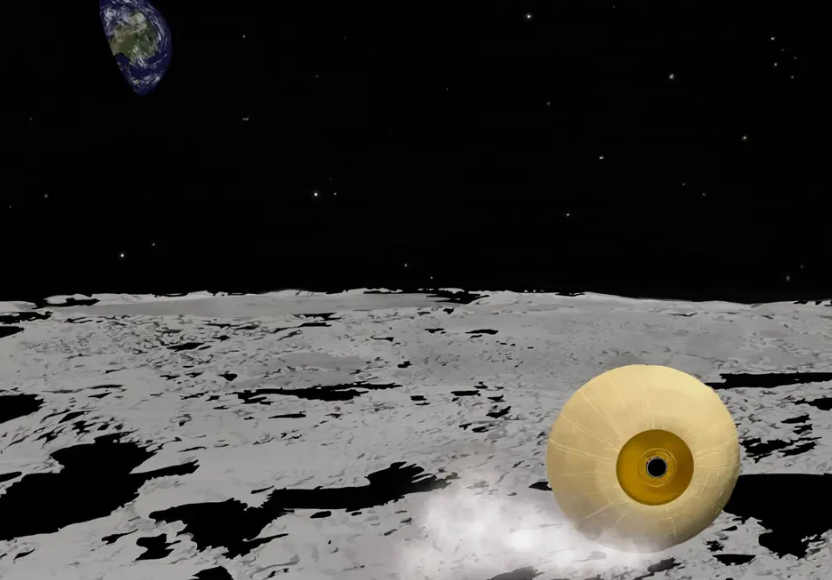 Source: Texas A&M University
Previously developed and then subsequently placed on hold at NASA, the RoboBall was designed as a “robot in an airbag," that is intended to explore uncharted and challenging terrains.
According to its developers, there are currently two versions in development: the RoboBall II and the RoboBall III. The RoboBall II version is a 2 ft diameter prototype has been developed for trial runs to test power output and control algorithms, while the larger RoboBall III features a 6 ft diameter that has been developed to carry various payloads, such as sensors, cameras or sampling tools, for future real-world missions.
The RoboBall will soon undergo extensive outdoor testing, including field trials on beaches, with these trials demonstrating the robot’s ability to transition from water to land.
By demonstrating its buoyancy and adaptability in such a setting, the researchers seek to prove that the RoboBall can navigate more environments beyond those of its wheeled or legged counterparts.
“Traditional vehicles stall or tip over in abrupt transitions. This robot can roll out of water onto sand without worrying about orientation. It’s going where other robots can’t,” the researchers explained.
Despite a few design challenges — specifically that any mechanical issues with the robot require total disassembly since it’s sealed within a protective shell — the RoboBall is proving itself with the RoboBall II already setting a new speed record by reaching 20 mph, which is roughly half of its theoretical power limit.
In the future, its developers envision that the RoboBall will be a fully autonomous and remotely deployable exploration tool that might be launched from lunar landers to map steep crater walls on the moon or deployed from drones to survey post-disaster regions on Earth.
Once deployed, a swarm of these robots could potentially map the terrain, send data back to operators and transport instruments to locations too dangerous or difficult for humans to access.
For more on the RoboBall, watch the accompanying video that appears courtesy of Texas A&M University.
