
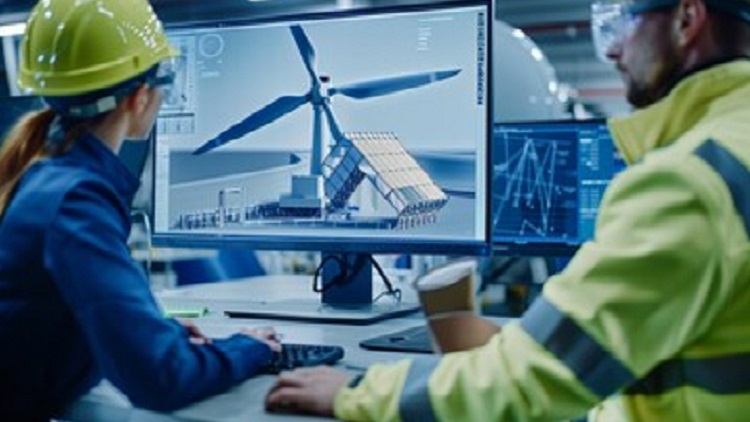
The integration of digital twin technology into wind turbine maintenance represents a significant advancement in the renewable energy sector. By enabling real-time monitoring and predictive analytics, operators can transition from reactive to proactive maintenance strategies, enhancing the reliability and efficiency of wind energy systems.
Creation of a digital twin
A digital twin is a virtual replica of a real wind turbine. The process begins with building a detailed virtual model, or digital twin, of a real wind turbine. This model receives continuous real-time data from the physical turbine through sensors that monitor variables such as vibration, temperature, wind speed, rotation speed and more. The goal is to create a live simulation that mirrors the turbine’s behavior exactly. With this digital replica, engineers can monitor the turbine’s performance remotely and detect early signs of wear and malfunction without relying solely on physical inspections.
For academic or research projects, MATLAB + Simulink can be used to create a basic digital twin model (especially for control systems of turbines). For small prototype projects, Python libraries (like TensorFlow + IoT data APIs) can be used to simulate digital twin behavior. Further, large energy companies are using Siemens NX and Teamcenter (with MindSphere) to develop industrial digital twins, including wind energy.
How it's made:
- Real-time sensor data (vibration, temperature, pressure, rotation speed and wind speed) from the turbine is collected.
- This data feeds into a computer simulation model that mirrors the turbine’s behavior in real-time.
Purpose:
- Continuously simulate and monitor the turbine’s performance.
- Identify any deviation from “normal” behavior early.
Integration of artificial intelligence (AI)
Next, AI — particularly a back propagation neural network (BPNN) — is integrated with the digital twin system. AI models are trained using historical operational data, including both normal performance and past failures. These AI systems predict how the turbine should behave under current conditions. By constantly comparing predicted behavior to the real-time behavior observed through the digital twin, the system can detect even minor deviations that might indicate potential faults. This enables early intervention before failures escalate into costly breakdowns. The overall workflow would be:
BPNN:
- Used for forecasting: Predict short-term future outputs like power production.
- Also used for anomaly detection: Spot subtle signs that a component might fail.
AI’s job:
- Compare the predicted behavior (from AI) to the actual behavior (from the turbine/digital twin).
- If the actual behavior is abnormal (e.g., unusual vibration patterns), AI flags it before a real breakdown happens.
Enhancement using historical meteorological data
To further improve prediction accuracy, the AI system also incorporates historical meteorological data. When present weather patterns resemble those recorded in the past, the model assigns more weight to those historical cases to fine-tune its forecasts. This hybrid approach of combining real-time data with historical insights enhances the system’s ability to predict ultra-short-term wind power output, especially during unexpected or extreme weather conditions. As a result, the turbines can maintain more stable operations under fluctuating environmental factors. The workflow would be:
AI forecasting with historical meteorological data:
- The AI doesn’t only rely on immediate sensor data.
- It searches through past weather patterns that are similar to current ones (e.g., a sudden stormy period).
- This improves the accuracy of future wind power output predictions.
Weighted adjustment:
- The BPNN output is "fine-tuned" by giving more weight to similar past situations.
- Makes predictions more robust even in changing weather conditions.
Predictive maintenance and operational decision-making
When AI detects anomalies or performance deviations, a predictive maintenance alert is triggered. This alert allows maintenance teams to schedule proactive repairs before actual failures occur. Moreover, the digital twin can simulate different maintenance strategies to find the most efficient and least disruptive repair schedules. These simulations consider factors such as turbine downtime, cost, and safety, helping operators make well-informed decisions. This proactive approach greatly enhances the reliability and profitability of wind farm operations.
The outcome would be:
- If AI detects anomalies early, maintenance is scheduled in advance.
- Digital twin simulates what would happen if maintenance is delayed — helping prioritize repairs.
Benefits:
- Less downtime
- Lower maintenance costs
- Longer turbine life
- Safer operations (especially for offshore turbines)
Alerting the maintenance team
When the AI + digital twin system detects that something abnormal is happening (for example, unusual vibration in the turbine blades or abnormal temperature in the gearbox), it immediately sends an alert. The following is the summary of the whole process:
- The anomaly detection algorithm notices that the real turbine behavior is different from the predicted healthy behavior.
- A diagnostic analysis runs to understand what kind of problem it might be — for example, "possible bearing wear" or "gearbox overheating."
- Based on historical data and AI predictions, the system suggests a recommended action, such as:
- "Inspect turbine bearing within 5 days."
- "Reduce turbine load until inspection is complete."
- The alert (with detailed recommendations) is sent to the maintenance team via:
- Control room dashboards.
- Email notifications.
- Maintenance management software (like IBM Maximo, or a custom wind farm maintenance platform).
So the maintenance team doesn’t just get a warning — they also get a clear recommendation on what to check, what to prioritize and what parts might be needed.
Conclusion
In big wind farms (like offshore wind farms), digital twins and AI for predictive maintenance is often automated — the AI, the work order generation and even spare parts requests are linked together to avoid any delays. By combining real-time data with historical patterns, the system improves the precision of wind power forecasts. Accurate predictions enable operators to schedule maintenance activities proactively, reducing unexpected downtimes. This further assists in efficient power grid management, ensuring stability and security.
