
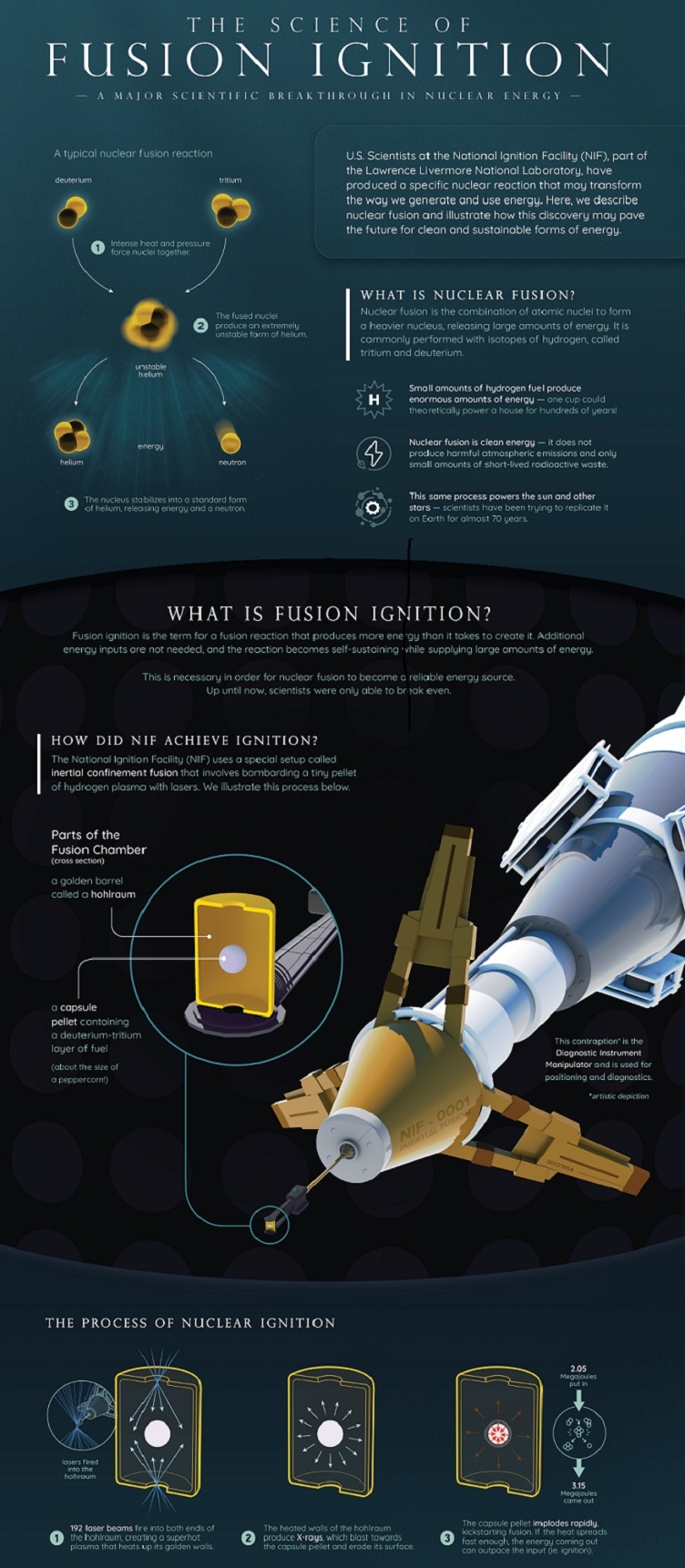
After more than 60 years of research, The National Ignition Facility (NIF) at U.S. Lawrence Livermore National Laboratory (LLNL) achieved fusion ignition in December 2022. Researchers produced more energy from nuclear fusion (3.15 MJ) than the amount of laser energy delivered to the fusion target (2.05 MJ).
The successful replication of the process that powers the sun and other stars offers the potential to provide a reliable, abundant, safe and clean source of electricity. The repeated achievement of fusion ignition at NIF has established the fundamental scientific feasibility of laser-driven inertial confinement fusion as a path toward fusion energy.
The technology entails directing laser beams into a cylinder, or hohlraum, through laser entrance holes at various angles. At the center of the hohlraum, the target capsule, filled with a thin layer of cryogenic deuterium-tritium (DT) fuel and a volume of DT gas, is bathed in X rays. The latter heat and blow off, or ablate, the outer surface of the capsule, causing a rocket-like implosion that compresses and heats the fuel in the capsule’s central hot spot to the densities and temperatures required to fuse the atoms. The resulting fusion reactions create high-energy alpha particles (helium nuclei) that accelerate into and heat the cold fuel surrounding the hot spot, generating an explosive, self-sustaining fusion reaction that leads to ignition.
Investigations are underway to engineer efficient drivers capable of achieving net energy gain, develop the ability to fire the driver at a repetition rate of 10 Hz or more to provide a continuous stream of energy to a power plan, and designing high-gain targets capable of emitting 50 to 100 times the input energy.
