
One of our approaches, he said, “Is to focus on crucial 'end-use' sectors that can benefit from a greener model. At the Innovation and Technology Centre in Bonn that I’m a part of, there are five end-use areas that are of key interest which include promoting the adoption of electric vehicles and energy storage solutions.”
Figures are on track but…
While the adoption of EVs has surged over the last 10 years, many doubt that the market will be able to grow enough to help reach net zero emission targets by 2050. According to the International Energy Agency (IEA), road transport contributes to one sixth of global emissions. It warns that to attain the net zero scenario, “electric car sales must reach around 65% of total car sales in 2030.”
While growth was on track in 2023, sustained efforts need to be made to stay on course, including the greater deployment of a charging infrastructure, which is not meeting requirements for the time being.
“The number of public charging points is increasing but deployment must accelerate,” the organization advises.
Range and charging anxiety are blamed
Interview any number of car owners who have not yet purchased an EV and they will blame the lack of charging points for their hesitation. Range anxiety, as it is often called, refers to how far EVs can travel without running out of battery power. But another type of fear, called charging anxiety, which focuses on the reliability of charging points, is also becoming widespread. According to U.K. power supplier National Grid, fears of long queues during peak charging times, vandalized or broken equipment, unreliable software or hardware, are putting off potential buyers.
The charging infrastructure involves complex electronics, which are standardized by the IEC. Several standards have been published to facilitate e-charging across countries, including the IEC 62196 series of standards, which cover the mechanical, electrical and performance requirements for plugs, socket-outlets, vehicle connectors and vehicle inlets for the connection between the EV supply equipment and the electric vehicle. The IEC 61851 series specifies the direct current and alternating current charging infrastructures, while IEC 63110 establishes the management protocol for the EV charging and discharging infrastructure.
When it comes to integrating EVs within the electricity network, TC 57 has recently published several standards that help EVs to function as suppliers of energy to the grid.
(To find out more, read the interview with Frances Cleveland in e-tech.)
The IEC is even preparing the ground for future technologies, which are not yet widespread. It has published several standards for wireless power transfer (WPT) — meaning the EV can charge its battery by stationing on an inductive pad on the ground, without any plugs or cables. Inductive WPT systems use magnetic field coupling between conducting coils embedded in the roadway and the vehicle. Dynamic WPT systems — enabling cars to charge on the go, while in motion — is a promising area as well, and the IEC has already published a publicly available specification (PAS) dealing with the technology.
A booming market that relies on international standards
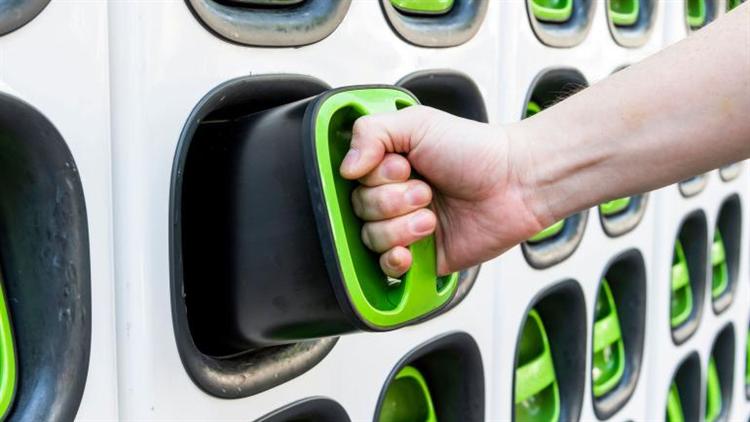
There is another solution that is doing a lot to alleviate EV buyer fears and that takes the charging element out of the equation: battery swapping. It involves replacing a depleted EV battery with a fully charged one at specialized swapping stations. The commercial prospects for battery swapping are very optimistic. According to this report by BCC Research, the market is expected to have a compound annual growth rate of 25,5% from 2024 to 2029, leaping from USD 894,2 million in 2024 to USD 2,8 billion by the end of 2029.
Forbes mentions several players already positioning themselves in the market: Chinese EV manufacturer NIO, battery giant CATL and San Francisco-based Ample are offering battery-swapping services in Europe, China and the United States. The IEC has been paving the way for battery swapping by publishing IEC TS 62840-1, which gives a general overview for battery swap systems in EVs, and IEC TS 62840- 2, which specifies the safety requirements for battery swap systems in EVs. An IEC Publicly Available Specification 62840-3, establishes interoperability requirements for battery swap systems operating with removable battery systems.
Pros and cons of battery swapping
Among the advantages of battery swapping are, firstly, time gains: even with a fast charging option, car owners have to devote at least 30 minutes to car charging — although a Chinese EV manufacturer claims one of its EVs is able to charge in 5 minutes. Other benefits include, perhaps a little counter intuitively, cost: buyers can purchase an EV without the battery, making it much cheaper to acquire upfront.
The battery swapping industry is also able to maintain batteries effectively, extending their lifespan, which is a plus in a circular economy approach. Battery swapping stations take up less space than EV charging stations which is a benefit in densely populated areas like cities. And from a utility point of view, battery swapping companies can recharge the batteries at very low electricity usage moments, or off-peak, thereby putting less pressure on the electric grid.
On the down side, batteries proposed by battery swapping companies do have a price which, in the longer run, could mean that battery swapping is less profitable for users than acquiring an EV with a battery. The options for current users are either to acquire a battery through a yearly subscription service, or on a pay-per-use system. Like with EV charging, the lack of infrastructure remains a challenge and many more battery swapping stations will have to be built for consumers to fully adopt the solution. Many of the existing stations offer manual instead of automated swapping, which can put some users off. Safety concerns exist as well: if a battery swap is not executed properly, a short circuit might occur, causing a fire.
That is where IEC Standards come in: by specifying the safety for battery requirements for battery swap systems, IEC 62840-2 helps to overcome some of the barriers for the system to become more widespread. IECEE (IEC System of Conformity Assessment Schemes for Electrotechnical Equipment and Components) is one of the four conformity assessment systems administered by the IEC. It runs a scheme that tests the safety, performance, component interoperability, energy efficiency, electromagnetic compatibility and hazardous substance of batteries.
As with plug and cable charging systems and with wireless transfer charging, IEC Standards and Conformity Assessment Systems are paving the way for tomorrow’s EV infrastructure.
