
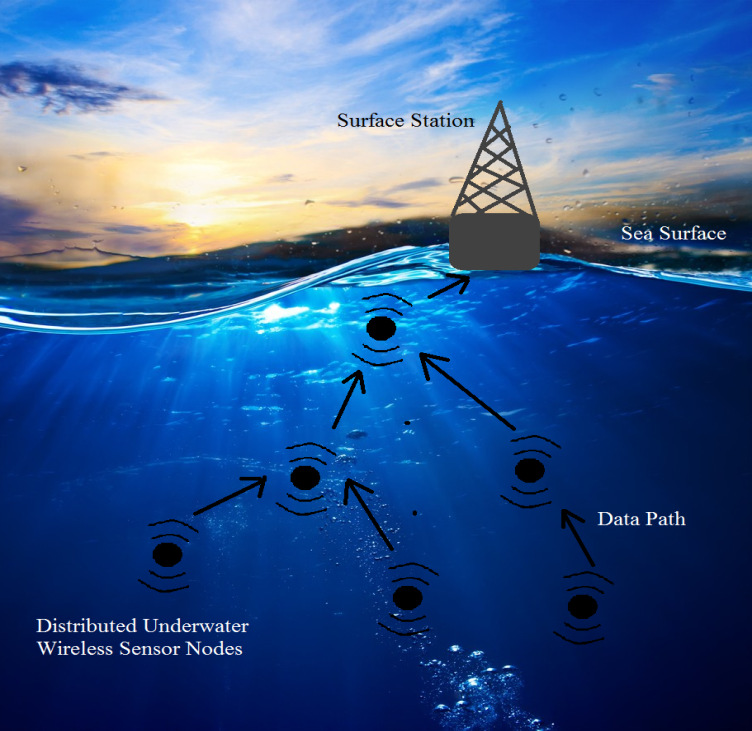
Oceans cover about 70% of the Earth’s surface and remain largely unexplored. With science and organizations seeking to expand research in water, developing underwater wireless networks (UWNs) is becoming a critical development for marine surveillance, military operations, disaster prevention, environmental monitoring and archaeological exploration.
While numerous UWNs exist, in recent years, most systems are seeking to combine high-bit rate and low latency with long-range. The issue is that long range has been regulated typically to older legacy technologies and newer technologies allow for better bit rate and latency but lack the range necessary for marine use.
The focus has switched to now integrating both types of technologies into one hybrid acoustic-optical underwater communication network that provides the best of both worlds.
What is a UWN?
UWNs refer to data transmissions through wireless systems — either through radio frequency (RF) waves, acoustic waves or optical waves — to provide higher transmission bandwidth while simultaneously providing higher data rates.
Acoustic waves are the traditional medium for UWNs due to its ability to travel long distances. The downside is this technology suffers from low data rates and high latency. Some modifications include integrating this communication with acoustic modems with modified TCP/IP protocols for underwater internet connectivity. But the quality of the transmissions remains not ideal.
Underwater optical wireless communications (UOWC) are a UWN with higher data rates and lower latency but that can only travel over short distances. Additionally, aquatic channel conditions pose great challenges for these networks such as:
- Absorption
- Scattering
- Turbulence
This means underwater optical wireless communications require localized solutions and more efficient networking.
More recently, hybrid communication systems have become popular in UWNs because they provide higher data rate, longer communication range and secure data transmission using optical fiber, underwater free space optics and free space optics.
Why it is needed
To facilitate underwater activities like environment monitoring, off-shore explorations, climate change monitoring and more, there has been an increase in the number of unmanned vehicles and devices that have been deployed underwater. Increasingly, these vehicles require high bandwidth and high capacity for information transfer underwater with data rates ranging from a few to tens of Mbps.
Wired underwater communication like fiber optics and copper cables is not feasible due to the engineering and maintenance issues associated with the technology. Therefore, UWNs have come into fashion to provide this high-capacity link with low latency and low power.
Optical wireless modems from Shimadzu Corp. are capable of high-speed underwater communication by sending and receiving green and blue laser light. These modems have a maximum communication range of 80 meters and can be mounted on an AUV or ROV. They can communicate between robots above and below water or to a ship at sea.
Many underwater wireless optical communication systems use LEDs as the light source, however some like Shimadzu use laser-diodes for better response rate and directivity, the company said. Combining this type of modem with the long range of acoustic waves could lead to major changes in how marine applications communicate.
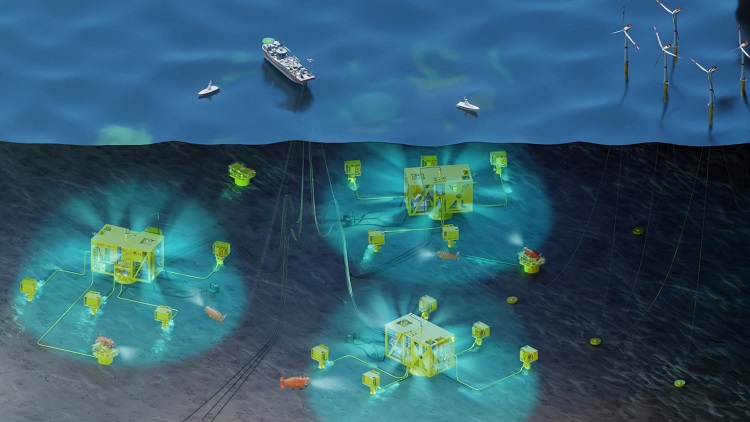 Optical wireless modems are capable of high-speed underwater communication by sending and receiving green and blue laser light. This could be the precursor to an overall larger UWN spanning ocean floors. Source: Shimadzu Corp.
Rough waters
Another critical consideration in developing UWNs is absorption and scattering in ocean water, two key phenomena that affect how signals travel through water.
Absorption refers to the process where energy from a wave (light or sound) is converted into heat and lost as it travels through water. This reduces the intensity of the signal over distance.
This is important for UWNs because different colors of light are absorbed at different rates. Red light is absorbed quickly, while blue light and green light travel farther.
Scattering on the other hand is when a wave hits particles — plankton, sediment or bubbles — in the water and bounces off in multiple directions. This could cause the signal to lose direction, reducing the clarity and range of UWNs.
Both water phenomena are reasons why UWNs are more complex than just air signals and why hybrid systems that combine acoustic and optical wave technology are being developed to balance the downsides.
Shallow to deep
Beyond these phenomena, water depth and different types of ocean water are also a challenge for those developing UWNs. From shallow water to deep ocean, each has their own different requirements and vary by geographical location.
Pure sea water — The absorption in pure sea water is the sum of the pure water and the salts. It is the main limiting factor in pure sea water due to the increase in wavelength — red wavelength of 500 nm is attenuated more than blue light, or why deep clear ocean water appears rich blue in color. These different colors impact UWN performance.
Clear ocean water — This type of water has a higher concentration of dissolved particles like dissolved salts, mineral components, color dissolved organic matters and more.
Coastal ocean water — This water has a higher concentration of dissolved particles and increases the turbidity level, meaning the effect of absorption and scattering is more evident in this water type.
Turbid harbor – This type of water has the highest concentration of dissolved and suspended particles, meaning the propagation of optical UWN is limited due to absorption and scattering.
 Key components of underwater IoT original data. Image and chart generated by ChatGPT.
Enter IoT
The internet of things (IoT) is opening new avenues in UWNs through use of underwater equipment and sensors to gather and transmit data in marine environments.
The so-called underwater IoT (UIoT) uses sensors, autonomous underwater vehicles (AUVs) and remotely operated vehicles (ROVs) and buoys to monitor, collect, transmit and even analyze underwater data in real-time.
The UIoT could be used in environmental monitoring and oceanography to monitor temperature, salinity, pressure, currents, pH and pollution levels through sensors. It could also monitor tsunamis and marine ecosystem protection.
Another potential use case includes deploying sensors and AUVs in oil and gas exploration to detect gas leaks, monitor seabed conditions and reduce manual inspections, and enable predictive maintenance.
Other use cases of UIoT include:
- Defense and surveillance
- Aquaculture
- Smart ports
Future use cases for UIoT involve swarm intelligence to have AUVs work like a “school of fish” or digital twins to provide real-time virtual simulation of underwater environments and integrating 5G networks for faster surface-to-sea data relay.
Accelerating growth
IoT provider CSignum is seeking to accelerate the growth of submerged sensors and wireless networks. The company raised $7.96 million to expand its portfolio of real-time data transmission devices for underwater and underground applications.
CSignum’s EM-2 devices are capable of transmitting data via electromagnetic field signaling (EMFS) that allows transmissions to networks above the surface with the ability to pass through:
- Water
- Ice
- Soil
- Rock
- Concrete
CSignum claims other wireless methods have successfully achieved this ability to date. This could be used in applications like water quality and environmental monitoring, wireless under-ship monitoring and security applications for infrastructure like offshore wind turbines and oil and gas platforms.
