
Researchers from Ulsan National Institute of Science and Technology (UNIST) have created a new method that enables them to engrave unique fingerprint patterns onto electronic skin.
According to its developers, the electronic skin features unique wrinkling patterns that surpass the uniqueness of even human fingerprints. This approach might one day enable artificial intelligence (AI) robots to possess unique fingerprint identification capabilities.
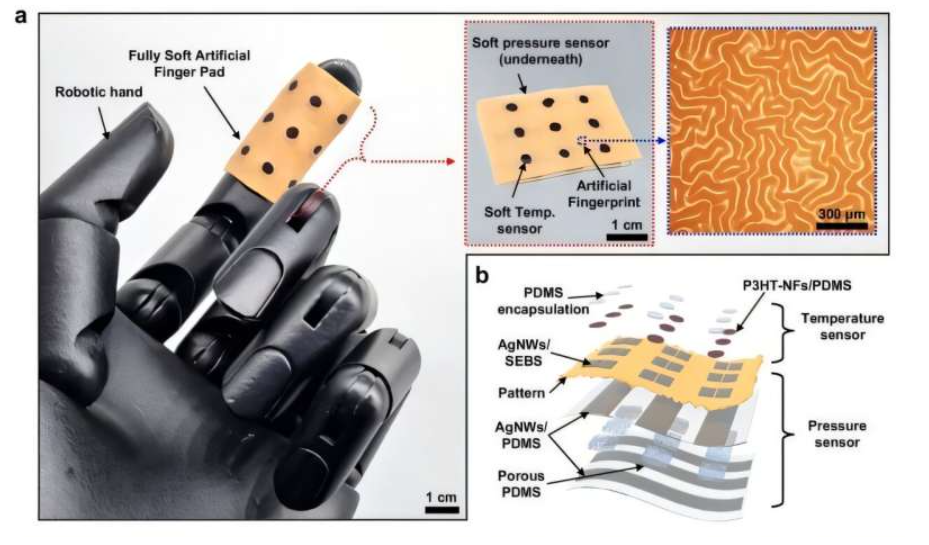 Source: UNIST
To develop the electronic skin, the team determined that they must incorporate sensors into the electronic skin to imbue it with tactile sensation while also maintaining flexibility. As such, the researchers concluded that flexible organic materials are more appropriate than rigid inorganic ones for this application. Furthermore, electronic skin intended for fingers must also be capable of distinguishing between specific objects, which makes it challenging to create skin that possesses both functionality and unique fingerprint-like patterns.
To engrave random wrinkling patterns on styrene–ethylene–butylene–styrene (SEBS) electronic skin, the researchers chemically treated a flexible polymer to first create the skin and then applied toluene solvent before spinning it rapidly. While the toluene evaporates, the surface of the skin contracts, forming the random and unique wrinkles.
The team discovered that the probability of this artificial fingerprint being replicated in the exact same shape is just 10⁻⁴³ based on a 1mm² area — a figure that is roughly 10²³² times lower than the probability for human fingerprints. When increased to the size of a human fingerprint, the probability of replicating the same pattern nears zero. The team added that the electronic skin is resilient to physical impacts, heat and humidity, which allows for the preservation of the fingerprint-like structure.
Applied to a robotic hand, the electronic skin enables the robot to grasp objects much like a human hand, allowing it to recognize surface textures and to distinguish between living beings.
"By employing a straightforward process, we have achieved a lower probability of creating identical patterns compared to actual fingerprints," the researchers explained. "This technology has broad potential applications in security and unique identification for future technologies, such as personalized electronic skin, soft robots with life-cycle management, and next-generation human-machine interfaces."
The approach is detailed in the article, “Irreproducible SEBS wrinkling based on spin evaporation enabling identifiable artificial finger pad electronics,” which appears in the journal Nature Communications.
