
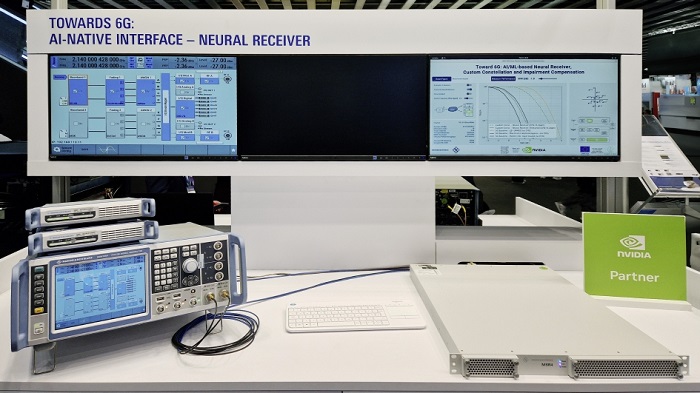
Rohde & Schwarz continues to push the boundaries of artificial intelligence (AI)-driven wireless communication research with its latest milestone in neural receiver design and testing. To be showcased at Mobile World Congress (MWC) 2025 in Barcelona, Spain, the latest proof-of-concept, developed in collaboration with NVIDIA, integrates digital twin technology and high-fidelity ray tracing to create a robust framework for testing 5G-Advanced and 6G neural receivers under realistic propagation conditions. The objective is to bridge the gap between AI-driven wireless simulations and real-world deployment, thereby facilitating more efficient and accurate testing of next-generation receiver architectures.
 Source: Rohde & Schwarz
This marks the fourth significant milestone in a long-term collaboration of Rohde & Schwarz with NVIDIA with demonstration showcased at past MWC events. The joint demonstrations have pioneered advancements in AI/machine learning (ML) for wireless communications over the past years, from the training of neural receivers for handling analog impairments to the design of custom constellations for pilotless communications.
At the core of the demonstration is NVIDIA Sionna, a GPU-accelerated open-source library for link-level simulations, which provides ray-traced wireless channel models to generate realistic radio frequency (RF) propagation conditions. The simulation results can then be seamlessly transferred to the R&S SMW200A vector signal generator from Rohde & Schwarz, which emulates complex real-world radio channels without requiring expensive external RF fading equipment. This advanced testbed enables testing and verification of AI/ML-based receiver algorithms and supports data-driven fine-tuning of neural components using realistic training data.
To ensure that the digital twin and ray-tracing models accurately reflect real-world conditions, the simulation is calibrated with data from a dedicated channel-sounding measurement campaign set in an urban street-canyon environment. By combining these precise measurements with NVIDIA Sionna, the ray tracer’s ability to model material interactions and electromagnetic propagation is further refined. The result is a calibrated version of the digital twin of the physical RF environment. This combination of technologies enables more accurate site-specific testing and validation of next-generation machine learning-based communication algorithms, including applications such as neural receivers and ML-based CSI feedback enhancements.
Rohde & Schwarz is a key contributor to global 6G research, collaborating with industry partners, research institutions, and standardization bodies to develop the next generation of wireless technologies, expected to be commercially deployed by 2030.
Visitors to MWC 2025 can experience this milestone demonstration live and speak with experts from Rohde & Schwarz and NVIDIA at the Rohde & Schwarz booth 5A80 in hall 5 of the Fira Gran Via in Barcelona from March 3 to March 6, 2025.
