
Hamamatsu Photonics is pleased to announce the launch of its latest indium gallium arsenide (InGaAs) photodiodes (PD) series designed for longer wavelengths. The G1719X series are near-infrared sensors offering high sensitivity and low dark current, comparable to conventional metal packages while featuring a surface-mounted ceramic design compatible with lead-free reflow soldering.
Available in four distinct sensitivity wavelength ranges and three varying photosensitive area sizes, the latest photodiode from Hamamatsu is tailored to meet the diverse needs of researchers and engineers across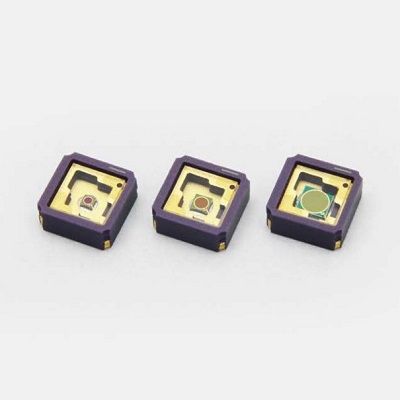 Source: Hamamatsu Photonics multiple industries, including gas sensing, remote temperature measurements and laser applications.
The compact nature of the G1719X series makes it particularly suited for installation in portable devices.
“Our new InGaAs PD offers increased performance and integration ease,” said Luigi Ghezzi, technical marketing engineer at Hamamatsu. “By combining high sensitivity and low dark current in a compact package, we enable seamless integration into various applications, thereby enhancing the reliability and performance of measurement systems.”
Key features include:
- High sensitivity: Choice of four sensitivity wavelengths from 1.7 μm to 2.6 μm and three photosensitive areas from φ0.3 mm to φ1.0 mm. Ensures precise measurements across a range of applications.
- Low dark current: Offering the same low dark current as conventional metal package products, the new NIR sensor range performs even in low-light conditions.
- Compact design: With a surface-mount ceramic package type and small size (2.9 mm x 2.9 mm x 1.2 mm), they are easy to integrate and are compatible with lead-free reflow soldering for long wavelengths, making it ideal for portable devices.
Hamamatsu's InGaAs PD is the ideal solution for industries focused on the latest compact technology and needing optimum accuracy. Engineers and researchers can incorporate this high-performance infrared detector to push the boundaries of what’s possible in their projects.
