
Although the newer process of surface mount technology (SMT) has largely replaced through-hole technology (THT) as a PCB assembly method for high-volume production, THT still has its place in prototyping and applications requiring greater reliability and durability.
Understanding this, Goepel Electronic continues to develop its THT Line · 3D system, which combines automated optical inspection (AOI) for THT components, THT solder joints and wave-soldered surface-mount device (SMD) components into a single system. Its latest innovation? A state-of-the-art 3D camera module that the company describes as “revolutionizing” failure detection while significantly reducing testing time and false call rate for THT solder joints.
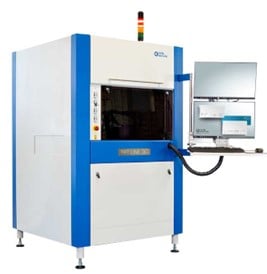 Continuing development of the THT Line · 3D automated optical inspection system illustrates the ongoing need for PCB assembly using through-hole technology. Source: Goepel Electronic GmbH As the inline system inspects THT and SMD components from the top, the new camera module performs an independent 3D inspection of THT solder joints and pins from below the conveyor belt. This allows the precise measurement of solder volume, solder flow and pin height along with the reliable detection of defects.
The camera module employs a camera-lens combination to achieve a larger field of view (FOV), increased image capturing speed and high-resolution image acquisition to support the inspection of SMD components close to THT solder joints — something especially useful in selective soldering. With a telecentric lens with a measuring range of up to 35 mm, the module also supports the use of different carriers in the production process and addresses the potential for variance between PCB-A and transport levels.
In addition, Goepel has taken special measures to meet the challenge of producing reliable height information during 3D measurements on the solder side, where reflections can be created by especially steep, very shiny and closely spaced solder joints. This challenge — which is faced by all 3D AOI systems — can be addressed through various interpolation methods, yet such interpolative corrections do not necessarily correspond to reality. Goepel’s answer is a “reflex reducer” that increases both data quality and measurement reliability.
Other advantages of the THT Line · 3D system include “flip free” double-sided THT assembly inspection. Assemblies can also be fed automatically or manually, with or without workpiece carriers; both component and solder sides can be inspected at multiple positions within the production line.
