
Automation is one of the fundamental technologies enabling the evolution of the industrial internet of things (IIoT), but its potential can be limited by real-world conditions. As a result, there are still some industrial tasks more likely to be served by a manual approach — leaving them open to human error and increasing the time it takes to accomplish them.
Through-hole technology (THT) assembly of printed circuit boards (PCBs) is a case in point. THT offers reliability and maintenance advantages over the more common surface mount technology (SMT) technique, but it requires a high degree of skill and precision that makes it challenging to automate. Manual assembly carries a higher risk of damage, which can mean greater rates of defect and lower yields.
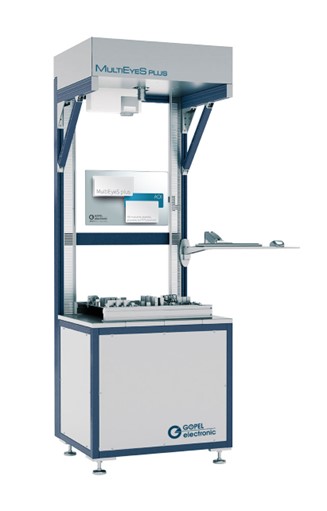 The MultiEyeS plus automatic optical inspection module can be configured to offer augmented reality-based user-guided assistance for challenging tasks such as THT assembly. Source: Goepel ElectronicYet as we’ve previously noted in Electronics360, augmented reality (AR) is opening new possibilities for optimizing manual assembly tasks. Goepel Electronic has followed this trend, bringing AR to the challenge of THT assembly through its MultiEyeS plus inspection solution.
The MultiEyeS plus is an automatic optical inspection (AOI) module based on a 47-megapixel image acquisition unit equipped with a flexible LED lighting system, providing high image quality and detail resolution with an inspection area of up to 650 mm x 550 mm. According to Goepel, the module is able to reliably verify the presence, position and color of THT components, read labeled or laser-edged 2D codes and barcodes, and recognize text.
The optional integration of a laser projector into the AOI module makes it possible to display information such as position or component type directly in the operator's field of vision. This AR-based user-guided assistance can help to prevent placement mistakes and achieve reproducible placement results. In addition to displaying information during the placement process, faults detected by the AOI during placement are also displayed directly on the PCB.
“Thanks to the direct integration of an AOI module at the location of the placement or assembly process, faults during placement or assembly can be detected and rectified in real time,” explained Dr. Jörg Schambach, product manager for industrial image processing at Goepel Electronic. “With the augmented reality technology extension, our MultiEyeS plus also ensures that operators are guided through the placement process in a user-friendly way. This is a huge advantage, especially when there is a large variety of products or new personnel need to be trained.”
The MultiEyeS plus can be used in a wide range of other applications as well, including assembly of components in casings, plastic parts and battery cells, along with incoming and outgoing goods inspection.
