Modern battery cells should offer performance as well as being environmentally friendly and sustainable on the road. The long-term goal is to move cars, buses, vans as well as construction machinery and trucks away from fossil fuels and toward electric drives based on battery and fuel cell technology. The revolution of previous drives has long been heralded, and the production processes are running at full speed. To increase the performance of energy storage devices while saving valuable resources, manufacturing processes are becoming increasingly complex. This requires innovative, high precision sensors that monitor the automated manufacturing processes inline.
 Figure 1. Sensors are used in all important process stages of battery production, solving various measurement tasks for machine monitoring, thickness control and quality assurance. Source: Micro-Epsilon
A lithium-ion cell passes through many stations before final assembly. Production can be divided into three main process stages: electrode fabrication, cell assembly, as well as formation and aging. Therefore, measurement sensors are required in all important process stages to solve various measurement tasks.
Coating
Wet film thickness measurement of the anode and cathode film
In the coating process, the film is coated either continuously or intermittently and over a width of up to 1,000 mm or even more. Important factors are the film and coating thickness, surface quality, cleanliness and avoidance of gas inclusions.
To monitor the wet film thickness of the anode and cathode materials, an accuracy of <±1 μm is required at 150 µm to 500 µm object thickness. For this measurement task, confocal-chromatic measurement sensors are recommended. To achieve a long-time signal stability with minimum drift, an automatic calibration unit should be installed. The confocal sensors measure the material surface from two sides using the differential method.
Based on automatic calibration with a reference target, the distance between the two sensors is determined at regular intervals. In measuring mode, the two sensors each detect the distance to the material surface. The material thickness is calculated from the known distance between the two sensors and the distance values. Thanks to the high resolution of the confocal sensors, they reliably detect even the slightest deviations. The high precision of ±0.25 µm and the measuring rate of up to 5 kHz enable fully automated thickness measurement. Using a linear axis to move the sensor system over the strip allows the complete transverse profile to be determined.
Drying
Drying process of the anode and cathode materials
Following the coating process, the coated aluminum or copper film passes through the drying process. The drying speed is up to 100 m/min at 80° C to 160° C. After drying the anode and cathode materials, a thickness test is necessary for quality assurance. The required accuracy is 1 µm for a target thickness of 75 µm to 400 µm. For this application, capacitive sensors are particularly suitable. The sensors are optimized for industrial requirements, extremely compact and deliver the highest accuracy in the submicrometer range regardless of whether the surface is glossy or matte.
Calendering
Calenders are used to compact battery cell materials, such as electrode films for lithium-ion batteries. Two adjustable rolls ensure that the material mixture is rolled to the specified thickness. For consistent quality, the roller gap must be monitored continuously and with micrometer precision. Due to restricted installation room very compact sensors are required, which measure at a 90° angle to the roller. Here, capacitive sensors with flat housing ensure compliance with the extremely low tolerances.
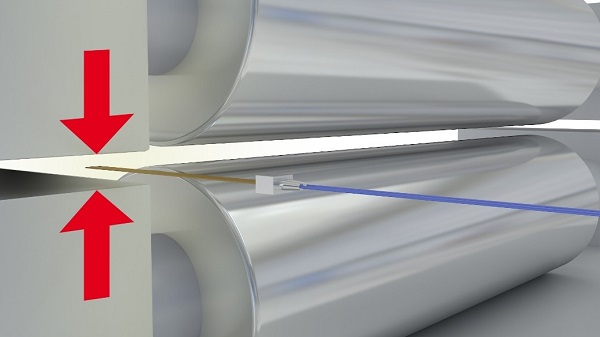 Figure 2. For consistent quality, the roller gap must be monitored continuously and with micrometer precision. Capacitive sensors ensure compliance with extremely low tolerances. Source: Micro-Epsilon
Innovative capacitive sensors should provide measurement values down to the submicrometer range even at extreme temperatures. In addition, the capacitive sensors must provide long-term stability without recalibration.
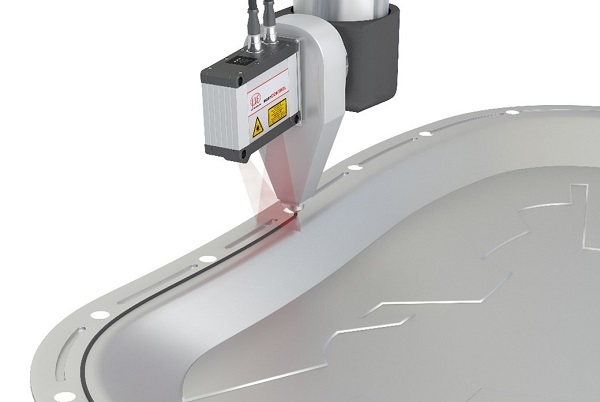 Figure 3. After the battery packs have been inserted, a heat-conducting paste is automatically applied between the bars to conduct the waste heat to the outside. Before the paste is applied, the volume between the bars up to the surface of the battery packs must be determined. Compact laser scanners take on this task. Source: Micro-Epsilon
Cutting
In this manufacturing stage, a coated parent coil is cut into several daughter rolls. This is done either by laser cutting or with a rotating knife. After slitting, curvatures and deformations often appear on the film. However, clean cut edges are crucial for high quality. Therefore, the edge curvature must be checked, which is why the edge profile is measured to micrometer accuracy.
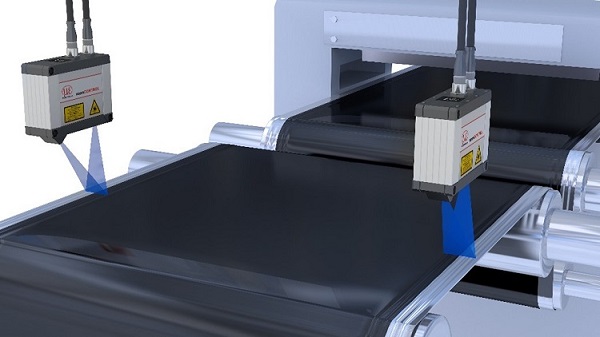 Figure 4. After slitting, curvatures and deformations often appear on the film. Therefore, the edge curvature must be checked, which is why the edge profile is measured to micrometer accuracy. For this purpose, laser profile scanners are used. Source: Micro-Epsilon
For this purpose, laser profile scanners are used. These are placed over the edge of the film and continuously record the profile. Due to their extremely high resolution and insensitivity to reflecting surfaces, these sensors provide stable measurement results and highly accurate 2D profiles, from which 3D point clouds can also be generated. These compact sensors can also be integrated into confined installation spaces.
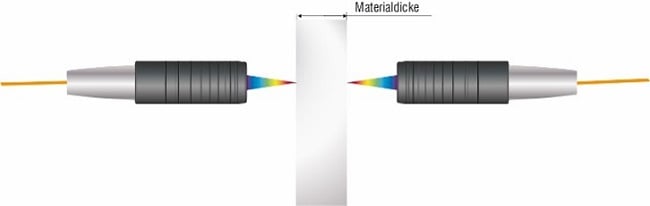 Figure 5. With double-sided thickness measurements, two sensors (confocal chromatic sensors in this case) are arranged opposite each other and measure the distance to the film. Depending on the type of sensor used, this arrangement achieves an extremely high resolution. Source: Micro-Epsilon
Cell assembly
Volume measurement when applying the heat conducting paste
After the battery packs have been inserted, a heat-conducting paste is automatically applied between the bars to conduct the waste heat to the outside. Before the paste is applied, the volume between the bars up to the surface of the battery packs must be determined. Subsequently, the volume of the applied paste needs to be measured relative to the volume in the empty state. Ideally, the volume of the paste is slightly higher than the volume in the empty state. Laser scanners take on this task. The scanner is attached to the dispenser and controls the application amount and the dispenser distance.
[Keep current on advances in sensor technology with a free subscription to the GlobalSpec Sensing Technologies newsletter]
Summary
These sensors are among the most powerful profile sensors in the world in terms of their accuracy and measuring rate. They detect, measure and evaluate profiles on different object surfaces without contact.
More importantly, they are key components to enabling a more electric future, due to their contributions in battery production.
About the author
Martin Dumberger, managing director of Micro-Epsilon America, is an expert for sensors and measuring systems with more than 30 years of experience in the sensor business. Based in Raleigh, North Carolina, he and his team handle complex and demanding measurement applications for almost any industry. Learn more about sensor solutions for battery production or watch the video: Precise sensors for battery production.
