
If you’ve lived or worked in a large city, particularly in Europe or the U.S, at some point you’ve likely handed your car keys over at a parking garage, trusting a professional valet to find a safekeeping spot for your vehicle while you went about your business. Typically, this goes off without a hitch. The vehicle is handled with care and is smoothly handed back when you return.
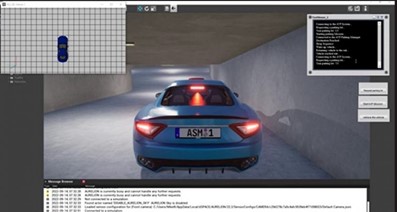 After receiving vehicle motion control commands across a 5G network, a virtual vehicle automatically drives in a parking lot according to instructions sent by the parking garage. Source: Anritsu Corp.Now imagine the same scenario, but without a driver. Automated Valet Parking, or AVP, is currently being developed as an autonomous driving use case for deployment in the short term. As proposed by the 5G Automotive Association (5GAA), AVP relies upon a wireless communication scheme linking Type-2 communication-cooperative vehicles with parking garage infrastructure and users’ smartphones.
Key to its success? You guessed it: testing.
AVP Type-2 requires highly reliable end-to-end communications; a test system needs to evaluate quality of service management and impairment effects in the IP layer, along with the wireless connectivity environment. A collaboration among Anritsu Corporation, dSPACE and Apposite Technologies, demonstrated this past October at the 5GAA Member Symposium event in Spain, solved those challenges through the use of a digital twin environment that incorporated both virtual and real devices. As Anritsu explained in a press release, this concept allows testing to improve the reliability of AVP Type-2 to start before actual devices are available.
In creating the test solution, Anritsu leveraged its MT8000A radio communication test station, which provides network simulation for 5G radio access technology and a development evaluation and certification test environment for a variety of automotive use cases. Regular readers may recall that Electronics360 reported on the device in January as a milestone in the development of connected vehicles.
The solution also makes use of a dSPACE software-based tool to integrate and simulate environment, infrastructure, sensor and vehicle information on a PC with an AVP system installed. Vehicle motion control (VMC) commands generated by the AVP System are transmitted to an original equipment manufacturer (OEM) application, which displays vehicle control state via 5G communication using the Anritsu 5G base station simulator. On their way to the OEM application, VMC commands also pass through an Apposite network emulator where IP data delay and data packet loss are added, simulating vehicle control instability. The ultimate goal is to provide AVP developers with data that will enable them to design control systems and networks to keep the vehicle stable.
Sounds like they’re well on their way: Anritsu says that automotive OEMs, Tier 1 suppliers and mobile network operators have shown great interest in the demonstration. The company plans to continue to develop the simulation environment to contribute to the realization of AVP.
No news yet on whether an automated valet would expect a tip.
