
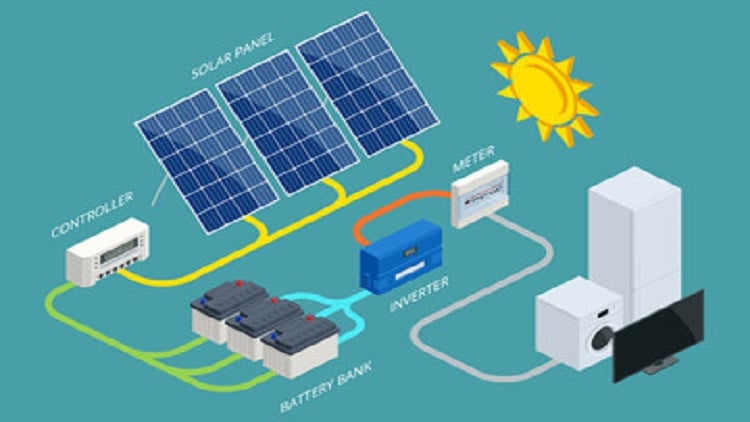
Inverters are essential systems helping to solve power outage issues in many residential homes and facilities. They feature a battery system that provides the DC voltage and an inverter that converts the DC voltage into AC to provide continuous power during a power outage.
However, as is the case with every battery system, knowing the load requirements and usage is essential before choosing an inverter system for any application. This ensures that engineers choose an inverter system with enough battery capacity and energy to meet the desired application needs.
What is the battery capacity?
Battery capacity (in amp-hour, or Ah) measures how much charge (or energy) can be stored by the device. It can also be defined as the number of hours a battery can provide a current (equal to the discharge rate) at its nominal voltage. For instance, batteries with a capacity of 1 Ah will be able to continuously supply 1 A to a load for exactly one hour, 2 A for ½ hour, or ¼ A for four hours before discharging completely.
Estimating inverter battery capacity: Six things to consider
1. Load calculation
To properly size the battery capacity needed for a household inverter system, engineers must first determine the total load (or wattage) of the appliances that the inverter will power. The more the load or wattage, the more the battery capacity would be needed to meet the load requirement.
Consider a scenario where there is a need to size an inverter battery for the following household equipment:
- 10 light bulbs (with a rating of 20 W each).
- Three standing fans (with a rating of 70 W each).
- Two plasma televisions (with a rating of 110 W each).
- Three portable laptops (with a rating of 50 W each).
- Mobile phones with a total rating of 25 W

Therefore, the total wattage of the pieces of equipment is obtained to be 805 W. The next step would be to determine the battery usage time.
2. Battery usage time (Back-up time)
This simply refers to the period the battery is expected to be used during a power outage before it runs out. The ideal battery usage time for an application generally depends on the power stability in the region where it will be used. For instance, in a region with stable electricity, engineers might want to size their inverters to offer a backup time of at least four hours.
3. Battery voltage rating
The voltage of the inverter battery is equally important. Most available inverter batteries have a 12 V voltage rating.
4. The efficiency of the inverter
Inverters convert DC voltage to AC voltage. During the conversion (i.e., the discharge of current from the battery), energy losses occur in the form of heat. These losses can be accounted for by using an efficiency parameter, which describes how much of the DC power is converted to AC power. It can be estimated using:
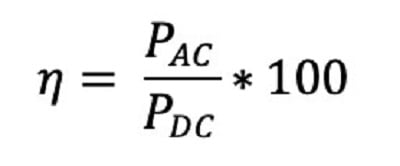
Where:
PAC = AC power output (W)
PDC = DC power output (W)
Inverter efficiency typically depends on the type of inverters and is usually specified by manufacturers in product catalogs. For instance, high-quality sine wave inverters typically have an efficiency of up to 95%, while modified sine wave inverters have an efficiency ranging from 80% to 85%.
Learn more about the different types of inverters on Globalspec.com.
5. Calculate the battery capacity (amp-hour)
The battery capacity in Ah can be calculated using the formula:

Consider the previous household example where the wattage was obtained to be 805 W. Suppose an inverter with an efficiency of 80% and voltage rating of 12 V is to be used as a backup power source for four hours. In that case, the total inverter battery capacity needed will be obtained as 335.42 Ah, as shown below:

6. Type of battery
It is not advisable to run a battery to zero during each discharge cycle, as it damages the device in the long run. Most batteries have a depth of discharge (DOD), which indicates the percentage of battery that should be discharged relative to the battery's overall capacity.
For instance, lead-acid batteries should only be discharged to about 50% of their charge during each cycle to prevent damage and extend its life cycle. In contrast, lithium-ion batteries have a DOD ranging from 80% to 95%.
Based on the battery type, the capacity can be calculated further according to the equation:

Consider the previous example where a battery capacity of 335.42 Ah was obtained. Suppose a lithium-ion battery with an 85% depth of charge is to be used in this application. In that case, the capacity can be obtained as 394.61 Ah, as shown below:

Additional things to note
Although inverter batteries come in different sizes and capacities, the exact capacity value obtained from calculations might not be available in the market. Therefore, design engineers are advised to select a battery with a higher capacity that is readily available in the market.
For most domestic applications, a 150 Ah battery capacity is often enough. However, it is always recommended to size an inverter based on the load calculation.
Conclusion
This article provides design engineers with the calculations and factors to consider when determining an inverter's battery capacity (in amp-hour) for household applications. However, engineers are also advised to reach out to inverter battery suppliers to discuss their application needs.
