
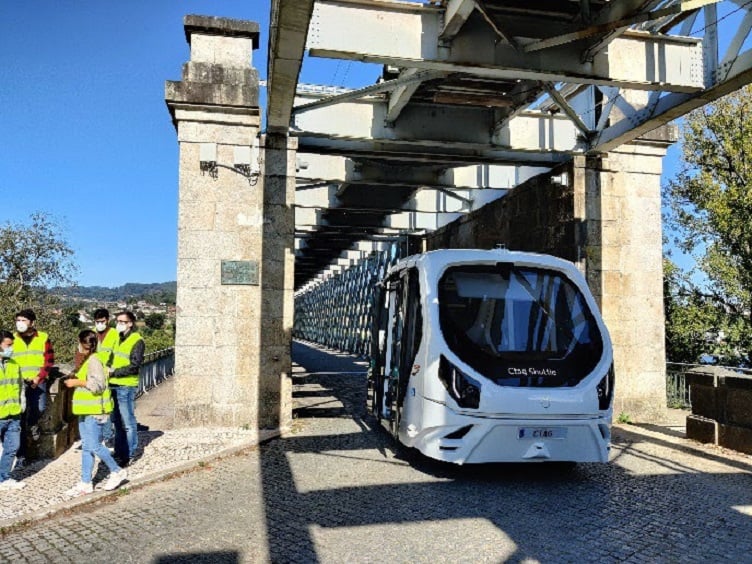
The first-ever 5G autonomous driving public demonstrations were held at the Spain-Portugal border this week to test various scenarios the high-speed cellular network could bring to automated vehicles.
5G-MOBIX demonstrated them at the International Bridge Tui Valenca on the Spain-Portugal border, a high traffic corridor. The corridor connects the cities of Vigo and Porto and covers the complete value chain from car manufacturers, telecom operators, public authorities and research institutions.
Autonomous vehicles would use the low latency and service continuity of the 5G network to bring traffic, navigation, service demand and other social aspects to public vehicles.
EU-funded, 5G-MOBIX wants to deploy 5G corridors along cross-border locations as well as urban areas to meet coverage demands of connected, automated vehicles. Additionally, the 5G network would provide business opportunities to develop 5G services and applications to autonomous vehicles, which would provide:
- Improved road safety
- Traffic management efficiency
- Driving comfort
- Reduced carbon emissions
“The EU’s single market benefits from seamless cross-border transportation, while at the same time connectivity suffers from interruptions when crossing borders,” said Coen Bresser, project coordinator at 5G-MOBIX.
What is 5G-MOBIX?
The initiative is an EU-funded program that brings together 58 partners from 13 countries from the EU, Turkey, China and Korea. The goal is to develop and evaluate automated vehicle functionalities using 5G core technologies along two cross-border corridors and six urban trial sites.
The program will develop and test autonomous vehicle functions using 5G core technologies for traffic, network coverage, service demand and other social and local aspects. Additionally, the program is testing cooperative overtake, highway lane merging, truck platooning, remote driving and vehicle quality of service support.
