
The expansion in work-from-home requirements and the ever-accelerating demand for streaming entertainment services has produced ripples throughout many industries.
One impact that is perhaps all but invisible to the public, yet critical to those who produce the infrastructure behind the scenes, is the sharply growing need for increasingly sophisticated Wi-Fi features — things like orthogonal frequency-division multiple access (OFDMA); multi-user, multiple input/multiple output (MU-MIMO); mesh Wi-Fi; and basic service set (BSS). The ability to test these features before they can be launched to the market is key to their success.
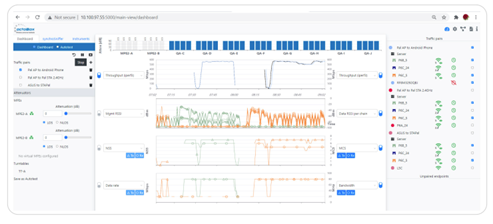 The dashboard of octoBox software 2.0 allows engineers to create new tests easily. Source: Sprient CommunicationsTo serve that need, octoScope, a Sprient company, has recently announced the release of octoBox software 2.0, a new version of the company’s web user interface that controls its automated wireless personal testbeds.
The 2.0 release brings productivity updates that will reduce the time needed for testing. A new dashboard mode allows engineers to create test scenarios more easily, for instance, while improved data visualization and plots make results easier to interpret and communicate.
In addition, upgrades to octoScope’s multiPerf traffic generator improve the ability to measure delay and jitter. Tight synchronization of instruments in the testbed allows measurements of one-way delay, along with producing in-depth statistics showing variations over time in delay and other parameters.
Those same multiPerf upgrades also make it possible to perform testing with any device.
Various off-the-shelf devices such as phones can be added to test scenarios; mutiPerf will control the device through USB and perform measurements wirelessly.
The new software leverages the power of parallel databuses and processing already built into all octoBox testbeds, allowing them to be used for emulation of multipoint-to-multipoint test scenarios involving dozens of real devices, while providing real-time feedback of test progress and results.
Key features and benefits of octoBox software 2.0 include:
- New dashboard mode that allows engineers to create new tests easily
- Improved plots
- Android and Windows support for multiPerf
- One-way delay measurements
- Faster creation of tests
- Faster analysis of test results
- Testing on more devices
Fanny Mlinarsky, octoScope founder and Sprient senior vice president of Wi-Fi products, stated that “octoBox software 2.0 greatly improves the productivity of the wireless test engineer and solidifies octoScope’s position as the easiest to use testbed in the Wi-Fi industry.”
