
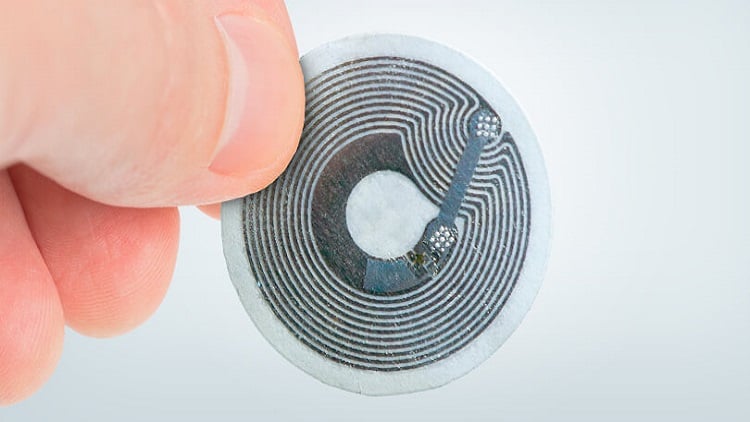
Near-field communication (NFC) chips enable easy data sharing between laptops, tablets, phones and other devices. The technology was developed as a result of radio frequency identification (RFID) advances that power the security scan cards that enable users to enter the office or skip the tollbooth when traveling to work.
NFC is similar to RFID, but connectivity is limited to about 4 inches, and that is why users must keep their phones quite near to the contactless scanner when using Samsung Pay or Apple Pay. This limited radius can be viewed as a significant security advantage, which is one of the reasons why NFC has exploded in popularity as a safe substitute for credit cards. The technology can also be used for purposes other than purchasing coffee at Starbucks, and can be tapped to share data between two NFC-enabled devices, such as images, videos and contact information.
A number of devices that use the NFC protocol have been classified as either active or passive. Active devices are capable of sending and receiving data, as well as communicating with other active and passive devices. Perhaps the most popular kind of active NFC device is a smartphone. Card readers on public transportation and touch payment booths are also examples of active NFC devices. Passive NFC devices have chips and more tiny transmitters, which can communicate with other NFC devices without needing their power source. They do not, though, process data from other channels and are unable to communicate with other passive devices. They are often in the shape of digital wall signs or advertisements.
NFC chip operating principles
Similar to Wi-Fi and Bluetooth and a variety of other wireless signals, NFC operates on the concept of transmitting data through radio waves. NFC is another protocol for sending data wirelessly. This ensures that devices must comply with precise requirements to interact properly with one another. NFC technology is built on old RFID concepts that used electromagnetic induction to transfer data, and induces currents into passive elements or simply transmits data. Therefore, passive devices require a power source and instead can be energized by the electromagnetic field generated by an active NFC device as it enters range. However, NFC does not have sufficient inductance to charge cellphones.
Modes of data exchange
The frequency at which data is transmitted via NFC is 13.56 MHz. Users have the option of sending data at 106 kilobits per second (Kbps), 212 Kbps or 424 Kbps. That is fast enough for a variety of data transfers, from contact information to share photos and songs. The NFC protocol presently supports three distinct types of operation that define the type of data that will be shared between devices. By far the most prevalent mode of operation in smartphones is peer-to-peer. This enables the sharing of data between two NFC-compatible devices. Both devices in this mode alternate from active and passive modes when transmitting and receiving data.
By contrast, the read/write mode is a one-way data transmission method. The active device, which may be the user’s smartphone, establishes a link with another device to read data from it. Card emulation is the final mode of data exchange. The NFC device can be used as a contactless or smart credit card to make purchases and access public transportation services.
Are NFC chips safe?
NFC data transmission is thought to be safer than Bluetooth or Wi-Fi data transmission, largely due to the NFC chip’s very short communication range, which is just a few centimeters. Attacks and data-stealing are potentially feasible with a great deal of struggle, but the invader will have to be in close proximity to the user and hold a reader, which is an extremely unlikely scenario in reality. Additionally, a data hacker may only be able to decrypt data stored on the NFC chip and when the data is being sent; even so, this would only be possible if the transfer was not encrypted, which occurs infrequently.
Numerous potential applications are safe: In peer-to-peer mode, data is usually in encrypted form when shared securely between two devices. While paying with NFC, the reader does not receive the user's actual bank information; instead, an encrypted copy is shown. As a result, anyone who intercepts the data will find it worthless. However, it can get complicated if attackers obtain a credit card equipped with an NFC chip. Even so, the suspects will be limited to making minor transactions with the card, as larger payments require personal verification. Additionally, users should proceed cautiously while reading NFC tags from unknown areas, as this could result in a malware contamination.
Conclusion
NFC chip enables the fastest path to establish connections between electronic devices and offers the quickest solution for transferring data between devices in the near vicinity. NFC is ideal if a user runs out of credit or data, or does not have access to Wi-Fi or a carrier signal, or does not possess a cable for PC data transfer. There will be an increasing number of solutions in the future that transfer data encrypted through NFC and identify users using biometric features such as facial recognition or fingerprints.
