
Reliable, fast, energy-efficient data transmission is a necessity in many industries and the need is growing. Photonics chips have an important role in meeting this demand for applications such as autonomous driving and medical imaging, and yet, their adoption has been slow due to the high cost of production.
Photonics chips rely on light rather than electrons, which makes them energy-efficient for data transfer with high bandwidth, as well as extremely fast and reliable compared to conventional electric chips. About 50% of the cost for photonics devices is associated with their assembly and packaging. The coupling of the optical fibers used for guiding light in and out of the device requires sub-micrometer alignment. Current methods for fiber alignment are labor intensive and time consuming, and most do not meet the requirements, particularly for large-scale production.
A new optical fiber array that is accurate at the sub-micrometer scale when coupling fibers to photonics chips is the subject of the thesis by Ph.D. candidate Matthijs van Gastel at Eindhoven University of Technology.
Van Gastel, a researcher at the Control Systems Technology group in the Department of Mechanical 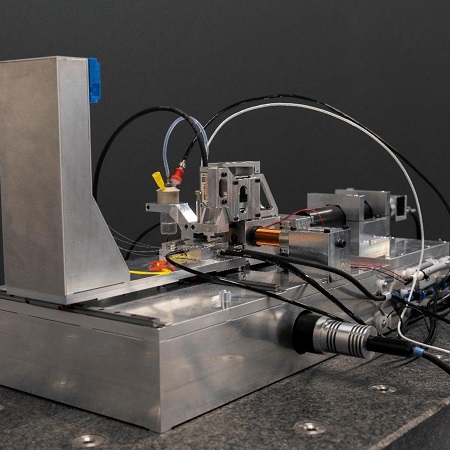 The realized fiber array assembly machine. Source: Eindhoven University of TechnologyEngineering, focused first on the development of the optical fiber array, and found a surprising solution: glue.
Current fiber optic arrays have difficulty adjusting to the variances in production quality (production tolerances) of optical fibers. This makes it quite difficult to reach the sub-micrometer accurate alignment for photonics chips. The new fiber array uses a camera system to measure the position of the fiber in order to compensate for production tolerances. Then the glue can be cured to secure the fiber to the glass plate.
Although glue can shrink and disturb the alignment, and also gradually change shape over time, the results of van Gastel’s simulations and experiments found the glue process exhibited very predictable behavior, which makes it suitable for optical fiber alignment.
Next, van Gastel studied the assembly machine for the newly developed optical fiber array. He used automatic action to ensure high accuracy in fiber alignment as well as lower costs and increased throughput. To achieve nanometer accuracy, the machine design incorporates three translational motion axes to align the fibers on the substrate in the most critical alignment directions. The machine’s compact, modular design allows for easy expansion to larger production lines.
As part of his research, van Gastel built and tested a hardware prototype of the machine design that is able to assemble a 16-fiber array in about four minutes. Traditional fiber alignment methods take from two minutes to an hour for a single fiber. Van Gastel’s assembled arrays had 18 times smaller alignment errors compared to currently available fiber arrays.
