
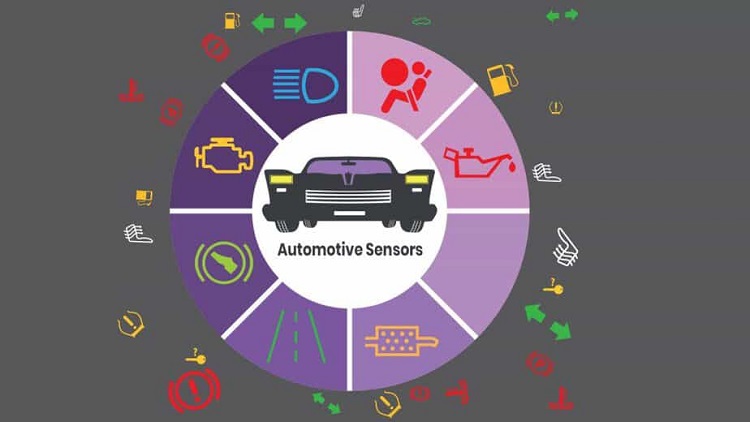
Onboard sensors combined with the internet have improved driving safety and have powered expansion of the automobile industry. The increasing sales of cars around the world and the launch of new vehicle technologies like self-driving cars are primary factors charging development in the automotive sensor industry. The need for sensors continues to grow in this sector due to heightened environmental standards, advances in safety systems such as airbags, comfort factors and electronic stability programs. This article describes some of the major sensors that are being used in the automotive industry.
Temperature automotive sensors
Temperature sensors have a crucial role in automotive performance and should be operated across a range of -40° C to 1500° C. The different kinds of temperature sensors used are silicon (Si)-based integrated circuit (IC) chips, resistive temperature detectors and thermistors. Si-based temperature sensor IC chips deliver high precision, durability, stability and linearity ranging from -55° C to 150° C. Such digital temperature sensors are made up of registers for monitoring IC functions, digital interface circuits, an analog-to-digital converter and a temperature sensor with a transistor present at its core. The output of these sensors is either digital, voltage or current. The emitter-base voltage of the transistor changes with temperature.
Resistive temperature detector automotive sensors typically include a metal with a positive temperature coefficient, with resistance and temperature directly proportional to each other. The temperature range of such sensors is from -240° C to 1000° C and they deliver medium sensitivity, decent linearity, reasonable time response, incredible life expectancy and high precision in comparison to other types. Thermistors depend upon the positive or negative temperature coefficient properties of ceramic-oxide composites, which allows them to quickly change resistance when subjected to a temperature change. Moreover, temperature sensors with a thermistor base can sense temperatures from -40° C to 250° C.
Pressure and gas automotive sensors
Pressure sensors are crucial for gauging pressure at the common rail, oil tank, fuel tank, inlet manifold, brake fluid, atmospheric ambient, chassis, air conditioner compressor, tire and adaptive suspension system. Such sensing is also crucial for ignition and fuel control systems. Gas sensors are primarily used to gauge the oxygen concentration in exhaust gases and secondarily to measure hydrogen, nitrogen monoxide and carbon monoxide concentrations. For example, at the emission control system, an oxygen concentration sensor can control the amount of polluting gas present or released.
Position and speed automotive sensors
Position sensors are vital components designed to measure throttle angle of engines, check the level of fuel, track steering wheel angle, measure the pedal position of brakes and accelerometer, select the gear position, record clutch position, measure seat position and monitor the position of the motor. When selecting a suitable position sensor, its measurement range, time response, operating condition, accuracy, cost, weight and size are some important parameters that must be considered.
Speed automotive sensors monitor the engine, crankshaft, wheel and camshaft speed and are utilized for gear shifting that is electronically controlled and input/output transmission control. The latest smart sensors are also the new hot component for the traction control system and stability of vehicles and antilock braking systems.
Mass airflow and inertial automotive sensors
Mass airflow sensors calculate how much air goes through an engine and quantify the steady-state and transient mass airflow. The engine's combustion process can be monitored by adding an appropriate fuel ratio into the mass flow of incoming air. Consequently, a calculation of mass airflow is important for determining how much fuel to put in an engine for regulating emissions, efficiency and expense. Inertial sensors help assess the state of motion of automobiles and perform a critical role in chassis control and safety systems. For safety systems, inertial sensors can be manufactured by utilizing surface technology, and for chassis control, these devices can be fabricated using bulk micromachining technology.
Torque and viscosity automotive sensors
Torque sensors in the automotive market are in higher demand now than ever before as the torque measurement in an automobile is crucial for enhancing the fuel efficiency of electric power steering cars. Such sensors are also employed for testing the gear and clutch boxes, dynamic torque of the engine and measuring strain. Moreover, viscosity sensors are being increasingly deployed to quantify lubricating oil properties and enhance the vehicle performance.
Conclusion
As today's automobile systems use a large number of control and electronics systems to ensure the comfort and dependability of cars, automotive engineers encounter various roadblocks when integrating the necessary electronics in the system. Power usage, signal integrity and packaging are the factors that should be considered when developing sensors for automotive systems.
