
Sponsored Content
Wireless Connectivity
LoRa® connectivity made smarter with low-power, front-end modules
11 November 2020
LoRa and LoRaWAN® basics
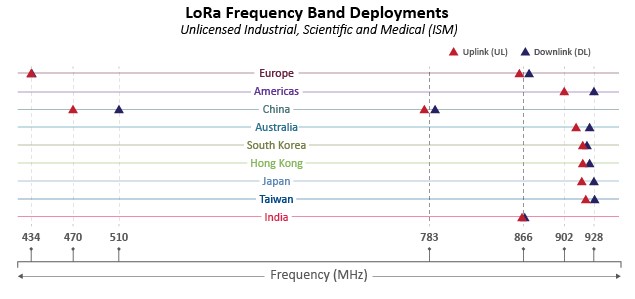 Figure 1: LoRa frequency band deployments globally. Source: Skyworks
LoRa, short for long range, is a low-power wide-area networking (LPWAN) technology operating in unlicensed ISM bands that is rapidly gaining traction within the internet of things (IoT). Devices deployed on LoRaWAN networks follow the LoRaWAN protocol specification as defined by the LoRa Alliance®, a technology alliance of more than 500 members. LoRaWAN-based IoT devices are expected to grow substantially in the next five years. According to ABI Research, unlicensed LPWAN connections are forecasted to grow from 305 million units in 2021 to 844 million units by 2026, a compounded annual growth rate of 23%.
Using a proprietary, chirp-based spread spectrum modulation technique, and operating primarily in unlicensed sub-1 GHz frequency bands (Figure 1), LoRa enables edge devices to connect to the cloud over long ranges while consuming very little power. This reduces the cost and power consumption for cloud-connected devices within a LoRaWAN network and serves as a complementary wireless connectivity technology to cellular, Wi-Fi and Bluetooth.
LoRa applications
LoRa offers an optimal connectivity solution for applications such as smart metering, industrial automation, sensor networks and asset trackers, where transmissions happen quickly and only when necessary.
For low-power, long-range transmissions, it is a communications technology that can balance data rate, range, capacity and power consumption. Systems that require bi-directional, narrow bandwidth data communications are a prime candidate for LoRa, especially those that must remain connected through walls, or over an entire property.
For example, LoRa based asset tracking tags can be used for security systems that monitor for location and movement of products or people, or for battery operated wireless sensor networks such as those deployed on bridges to measure structural integrity.
Challenges developing a LoRa product
Designers of LoRa-based end devices face several challenges in getting a product to market, where hardware, software and cloud connectivity must all seamlessly integrate and operate.
One of these challenges is designing a product to support various power levels based on geographic region and end application. As LoRa modulation uses spread spectrum techniques, end devices can be designed to transmit up to the maximum allowed levels for each specific region. For example, in North America, the maximum allowed transmit power for spread-spectrum radios is +30 dBm (1 W), while in Europe it is +27 dBm (0.5 W).
LoRa transceivers advertise their integrated power amplifiers (PA) can efficiently transmit, in some cases, up to +22 dBm from a 3.7 V battery. However, for decaying or reduced battery voltages, the maximum power that can be transmitted declines significantly.
These transceivers also provide the option to use an internal voltage regulator to maximize efficiencies and maintain a constant output power. However, using an internal voltage regulator doesn’t resolve the issue of delivering more power at lower battery voltages. It even comes at a penalty of increased size and BoM cost, as the voltage regulator operation requires the use of a large external ~15 µH inductor.
Another critical challenge is meeting regulatory (i.e. FCC, CE) compliance on spurious emissions. Compliance requires adding an intricate harmonic filtering and matching network between the transceiver and antenna switch. For product designers with limited experience in RF design, this can result in multiple design iterations that delay the time to market.
The question every product designer must ask is: can they design a LoRa product that works across geographies with different regulatory emissions requirements while meeting current consumption and size targets? By using a LoRa transceiver alone, it is highly unlikely the outcome will be optimal given the significant challenges outlined.
Making LoRa radios better
A front-end module (FEM) can be utilized between the transceiver and antenna to efficiently optimize both the transmit range and receive sensitivity. A FEM integrates transmit power amplification, receive low noise amplification, antenna switching between the transmit and receive paths, and the required matching and filtering.
Commercially available LoRa transceivers are typically designed in a singular process technology such as complementary metal-oxide semiconductor (CMOS). While this common process works well for digital blocks, CMOS is not an optimal process for power amplifiers, especially for efficiently delivering power levels routinely used in the majority of LoRa applications.
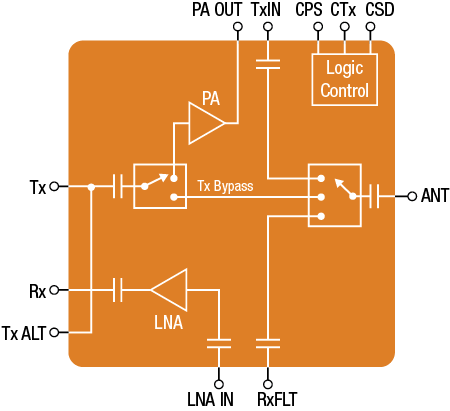 Figure 2: SKY66423 – part of the SKY6642x family. Source: SkyworksBy comparison, highly integrated front-end modules can leverage multiple integrated circuit process technologies including gallium arsenide (GaAs), silicon germanium (SiGe), or silicon-on-insulator (SOI), utilizing the optimal process technology for each functional block.
By integrating multiple die of optimal process technology and passive components into a single package, a FEM can be designed to be SoC agnostic, use different architectures, output power levels and gain configurations to address varying use cases and applications.
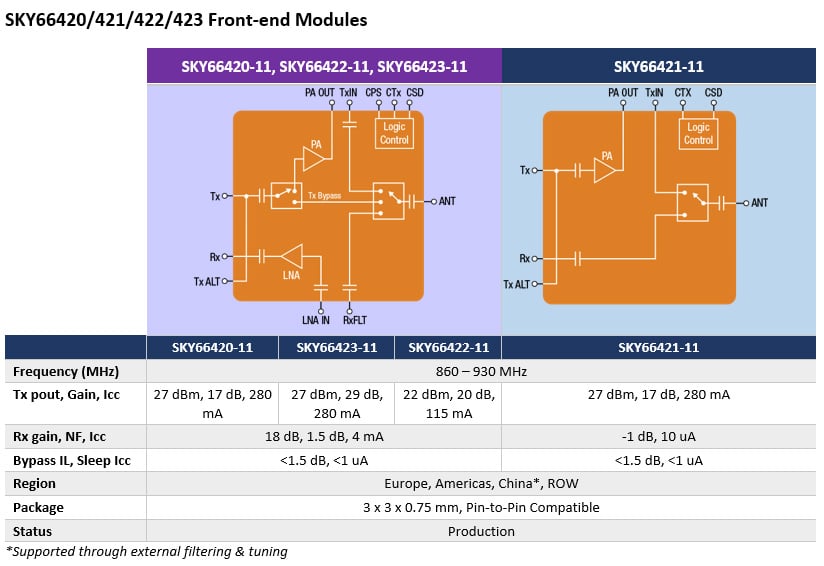 Figure 3: The SKY6642x family. Source: Skyworks
Skyworks’ LoRa FEM products
As a leader in wireless connectivity solutions for IoT, Skyworks has developed a family of FEMs for the growing LoRa market. The SKY6642x (Figure 3) consists of four pin-to-pin compatible parts offering tradeoffs in RF performance and functional architecture and useable with commercially available LoRa transceiver platforms. These parts are specified to be harmonically compliant at maximum power and over the full operating frequency range – simplifying end-product development costs and efforts.
For designs such as LoRa gateways supporting both +14 dBm and +27 dBm power levels, the SKY66420 can be used either in active mode or bypass mode, using the internal PA of the SoC with or without the FEM, requiring minimal software changes.
For designs exclusively supporting +27 dBm transmit power levels, the higher Gain SKY66423 can be used with the SoC internal PA at a backed off power level. This results in a lower total current consumption (SoC + FEM) when compared to the SoC only implementation. At 915 MHz, the SKY66423 itself has a power-added efficiency (PAE) exceeding 50 percent.
In receive mode, the SKY66420/423 have a gain of 18 dB and a noise figure of 1.5 dB, improving the range that the LoRa device can be away from the gateway. While LoRa receiver sensitivity is dependent on the bandwidth and spreading factor, by using the LNA in the FEM, the SoC internal LNA gain can be reduced to save power while simultaneously realizing a sensitivity improvement exceeding several dB.
As IoT devices become increasingly connected through low-power wide-area technologies such as LoRa, Skyworks is offering unique connectivity solutions that enable these devices to perform better, save power, and seamlessly scale across geographies. Skyworks FEMs are already helping LoRa device makers overcome design challenges and get to market faster, and will continue to evolve as new applications emerge today and into the future.
About the authors
Sri Sridharan
Sri Sridharan is a senior product marketing manager at Skyworks Solutions, Inc. where he focuses on defining and launching innovative RF front-end solutions for IoT by championing leading wireless connectivity technologies. A published author and award-winning product definer, he has held various roles from design and applications engineering to product marketing spanning a 20-year career at Skyworks, IBM, pSemi and MTI.
Sri has a bachelor’s degree and master’s degree in electrical engineering from the University of California at San Diego, and a certificate of marketing from the University of California at Irvine.
Stefan Fulga
Stefan Fulga is a director of product marketing for Internet of Things products at Skyworks Solutions, Inc. In this role he is responsible for defining new markets, developing new product specifications and new applications with a focus on smart energy, home automation, automotive, wearable and the industrial IoT market segments. Prior to Skyworks, Stefan served in multiple roles at SiGe Semiconductor, Inc. as a director of engineering and director of marketing. Stefan holds several U.S. patents and is a published author.
Stefan graduated with distinction from Concordia University where he received a bachelor of engineering degree. He has completed the Harvard Business School’s Program for Leadership Development.
Powered by CR4, the Engineering Community
Discussion – 0 comments
By posting a comment you confirm that you have read and accept our Posting Rules and Terms of Use.
Advertisement
Advertisement
Popular News
Find Free Electronics Datasheets

Advertisement