
Modern computers, microelectronic devices and other high-power density systems require efficient thermal management to keep these heat-generating units cool. University of Central Florida researchers are testing pulse jet cooling as a means of transferring heat away from electronics and to provide real time cooling.
Experiments used small water-jet nozzles to spray a hot titanium-coated glass window surface. Water flow was controlled using a mechanical chopper wheel, coupled to a DC motor, with designated holes to separate the free stream jet into tiny segments or pulses. High-speed infrared thermal imaging provided data for analyzing heat transfer coefficient (HTC) maps for a range of heat fluxes. The HTC in the water jet impingement zone increased as the jet pulsation frequency increased.
Under the test conditions, about 8 mg of water/pulse cycle were needed to remove 600 kW of heat from a one-square-meter of titanium surface. The hot surfaces are impacted by cold water jets in a pulsating manner, fostering heat exchange, and the heated water is withdrawn from the system by exhaust ports.
Conventional water-jet cooling technologies use free stream jets with greater volumes of water and can cause flooding, resulting in lower cooling performance. The lower amounts of water consumed in the pulsed jet impingement approach prevent flooding or even dry-out conditions.
The thermal management technology described in Physical Review Fluids can be applied in space and ground-based systems including electric vehicle batteries, data centers, telecommunication equipment and turbine systems.
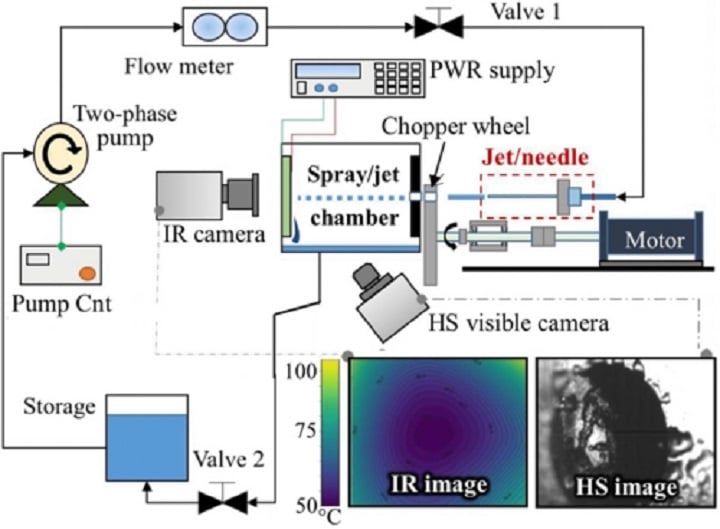 Schematic diagram of the apparatus and flow-loop for pulsed jet impingement studies. Source: Khan Md. Rabbi et al.
